Creator Hub

Eric Hsiao: How a Film Editor Directed a Six-Minute AI Drama on Higgsfield

Higgsfield10 min

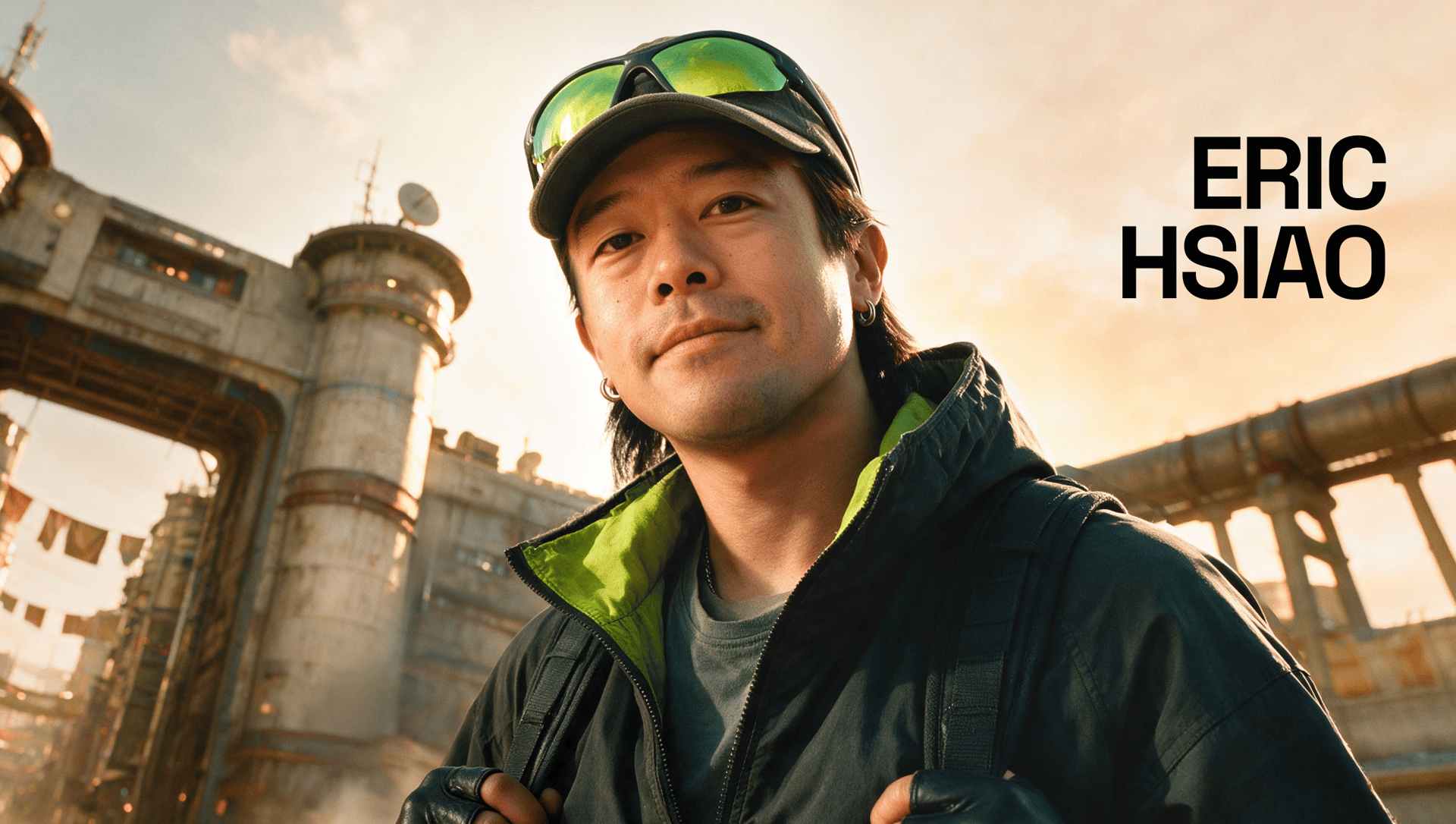
Eric Hsiao spent a decade cutting brand and event films as creative director at Desmond Studio. In 2026 he made THE THAW, a six-minute dramatic short with dialogue and two child leads, on his own in about three and a half weeks of part-time work. The video, dialogue and lip sync were generated in Seedance 2.5 on Higgsfield, the AI-native creative suite. Eric is a member of the Higgsfield Creator Partnership Program.

Who Is Eric Hsiao?

Eric Hsiao is a Los Angeles director and editor who publishes his films under the name Hard 8. Before moving into AI filmmaking, Eric co-founded Desmond Studio, where he worked as creative director and led post-production from 2016 to 2025. Through the studio, Eric cut films for brands such as Google, Anthropic, Figma and The North Face. He describes his move to AI as getting his hands on every part of a film for the first time, “end to end, from the world and the script through the shot itself to the final mix.”

His work in credits:

  • Desmond Studio, 2016 to 2025: co-founder, creative director and head of post-production, cutting brand and event films
  • Hard 8, 2026: THE THAW, LONG WAY DOWN and TAKE YOUR TIME, all fully generative
  • Higgsfield: member of the Creator Partnership Program

Two editing skills carried straight over:

“The first is selection. Generating a take is cheap now; choosing the right one isn’t. The second is coverage. I plan wide, medium, insert and reaction the way I’d cut a real shoot, and the cut hides the drift between takes, which is how editors have always handled continuity.”

Eric Hsiao

What he had to learn from scratch was everything he used to hand to a department: music, sound effects, wardrobe, props, set design, lighting, camera, casting. And how to write for a model.

Results at a Glance

Results at a Glance

Project

Format

Time

Result

THE THAW

6-minute narrative short, the first story from THE THIRD LAW

About 3.5 weeks part-time, August 19 to September 14, 2026

One of about 5,000 final films submitted to the Higgsfield Global Film Festival; its reel has brought paid inquiries

LONG WAY DOWN

One continuous 14-second stunt

A couple of days part-time

Prompt cut from 2,700 to 900 words with a Blender blockout

TAKE YOUR TIME

Spec ad, three characters in one room

About two weeks part-time, script to launch

Made for the CPP Halloween Challenge; live now

Team

One person on all three projects

-

Solo

All figures come from our interview with Eric Hsiao and from his site, hard8.co. “Credits are the small number and hours are the big one,” Eric says.

Why Make a Quiet Six-Minute Drama?

THE THAW is set in THE THIRD LAW, a world run by AI. AI needs enormous amounts of cooling, so cold became the economy. The dead are kept frozen on whatever balance they leave behind, and when it hits zero, the state offers the one thing it has in surplus: heat.

The film follows two children on the morning their grandmother’s balance runs out. They pack what is left and carry it to the municipal columbarium, where a clerk explains the last option. Nothing is explained on screen. You watch the meter.

Eric picked a quiet story on purpose:

“Spectacle forgives. A burning city can be wrong in a hundred places and still land. A held close-up on a twelve-year-old’s face can’t be wrong anywhere.”

He wanted to know whether the tools could carry drama. His answer: they can, and they still have some distance to go. He is just as clear about where he stands on AI and production:

“I don’t think AI should replace production. Plenty of films need a camera, a crew and real actors. My bet is that hybrid filmmaking is the future, with generative tools covering what a shoot can’t afford or can’t reach.”
How Was THE THAW Made?

The whole project lived in one Cinema Studio project on Higgsfield, which held 2,365 assets, according to Eric’s site. The production ran in four stages:

  1. World and script. Eric worked out the economy, the city and its rules in Claude before casting anyone, “because every hole in the world shows up as a hole in a frame.” He wrote two scripts and picked one.
  2. Pre-production. Characters, costumes, props and locations were generated as stills in GPT Image 2, GPT Image 2.5 Sunburst and Nano Banana Pro. Each became a locked reference plate (character sheets show front, back and face) and then a tagged Higgsfield Element, so later prompts reference the Element instead of describing it.
  3. Production. A starting still for each shot that needed one, then video in Seedance 2.5, beat by beat. Seedance generated the dialogue and lip sync inside each shot.
  4. Edit. A live cut in Premiere Pro ran the whole time, so the film was always watchable and showed which shot needed the next generation.
How Was THE THAW Made?

Stage

On Higgsfield

Outside Higgsfield

World and script

—

Claude, which also checked each prompt for contradictions

Characters, sets, props

Stills, reference plates, Elements

—

Shots, dialogue, lip sync

Seedance 2.5

—

On-screen text

—

Lettered by hand in After Effects

Small visual fixes

—

After Effects

Music and sound effects

—

Suno, ElevenLabs

Edit

—

Premiere Pro

Every readable word on screen was lettered by hand, because the models draw a document’s layout well but cannot yet spell reliably.

As Eric notes on his site, “No real person’s face or voice went into any input, including mine.”

How Did He Direct the Clerk Scene?

The clerk sits behind a glass window. The camera is on the children’s side, and the children are out of frame. It is the scene where Eric’s editing habits turned into direction.

  • Eyelines as numbers. In early takes the clerk looked straight into the lens and seemed to address the audience. The fix was a positional reference showing both children just off the lens, Hao on the left and Wen on the right, a head shorter. The prompt then gives the gaze as a number: five degrees left of the lens toward Hao for one line, five degrees right and down toward Wen for the next. Larger offsets read as staring off to the side.
  • One change, not a mood. The clerk is written as procedure for the whole scene. On the last line only, the procedure drops and he turns gentle. Giving the model one change to make proved more reliable than asking for a mood.
  • A voice spec. Seedance generated his lines from a written description: a man in his fifties, dry, flat sentence endings, slightly muffled by the glass. Eric judged each new take by ear against the first good one, so the clerk stayed the same man.
  • Every reference has one job. The desk holds one thin stack of papers in both shots, because anything the prompt does not account for, the model invents. When the clerk held a form up to the glass, he kept ending up on the children’s side of the window. That moment became its own hands-only insert.

Which Shot Took the Most Work?

The family leaving the flat: one 18-second tracking take. It opens on a bead of sweat on Hao’s forehead, because the heat arrives the moment the cold is gone. He wipes it, shoulders the duffle and picks up the box. Wen watches him, her brow dry, and pulls a pinwheel from the vent on her way out. It is the first time the film states its rule: he sweats, she does not.

The failed takes broke in small ways. The duffle strap vanished from Hao’s shoulder. Wen snapped the pinwheel’s stick instead of pulling it out. The tape and the notice disappeared from the table.

Some problems were fixed by making the prompt more specific. Others required changing the reference image before generating again. The pinwheel comes out “the way a key comes out of a lock.” The objects on the table got their state spelled out, because an object the model already knows about cannot be removed by leaving it unmentioned. Anything that needed to be gone, Eric removed once in a still, so later shots inherited an empty vent instead of asking the video model to erase it.

His rule for when to regenerate:

“A take that’s 90% there gets fixed in After Effects, which costs minutes instead of credits. After two edits on a good take I stop, write what they fixed into the base prompt, and roll fresh. I change the scene only when the same failure survives clean rolls.”

He had a fallback that split the shot into three. He did not need it. The one-take landed the day before submission.

How Did Blender Shape LONG WAY DOWN?

LONG WAY DOWN is one 14-second stunt: Wen goes backward off a roof, catches a clothesline, swings onto a balcony and rolls into a crouch as an elevator rushes past. Eric directed the route, timing and camera in chat, and GPT-6 Astra built each version in Blender through Higgsfield for Blender. Wen’s stand-in is a box with a blue face for her chest; an articulated mannequin made the generated movement stiff. The rendered blockout went into Seedance 2.5 as the video reference, and the prompt shrank from 2,700 words to 900. In his words, “Blender owns the camera, the prompt owns the contacts, and the model fills in the body.”

The LONG WAY DOWN stunt, intercut with its Blender blockout: a box stands in for Wen, and Seedance 2.5 fills in the body.

What Did TAKE YOUR TIME Add?

TAKE YOUR TIME, a spec ad made for the CPP Halloween Challenge, has the most developed pipeline of the three. Three characters share one room, and the comedy depends on timing. Eric blocked the kitchen in Blender with color-coded shapes before generating any shot. Seedance generated the dialogue in-shot as a guide track, and the final voices were made separately in ElevenLabs. Approved takes were generated at 480p and then upscaled in Topaz Video AI, according to his site. It is also the first film run through Genflow, a shot tracker Eric built himself that links every take to the prompt version that made it.

Inside the Creator Partnership Program

Eric is a member of the Higgsfield Creator Partnership Program. What the program is, who it is for, and how it works is covered in our dedicated article; here is what it looks like from inside one production.

What the program covers:

  • A monthly plan and generation credits
  • Early access to new models
  • A direct line to the Higgsfield team
  • A community of creators worldwide

What it changed in his production:

  • He could run a shot until it was right instead of settling for the first good-enough take.
  • The credits covered tests that never made the cut, such as generating a whole scene’s cuts in one pass or setting a camera angle from a top-down plan.
  • He now uses what he learns through the program to pitch inbound clients.

“CPP changed what I could attempt.”

Applications to the program are open on the Creator Partnership Program page.

What Have the Projects Led To?

THE THAW was one of about 5,000 final films submitted to the Higgsfield Global Film Festival. Eric says the film’s reel has brought paid inquiries, including a producer who asked for a full AI episode with THE THAW as the reference. Eric is using what he learns to pitch inbound clients and build spec commercials.

What Creators Can Take From This Project

Build the world before you cast. Eric settled the economy, the city and the rules before generating a single character, so the frames had nothing to contradict.

Write for a literal reader. A crew fills gaps with experience; a model does not. “Her right hand” flips when the camera moves, “no stairs” puts stairs in the shot, and “too big” means nothing until you say “the size of a roll of duct tape.”

Give direction as numbers. Five degrees off the lens worked for the clerk’s gaze; larger offsets read as staring off to the side.

Ask for one change, not a mood. One shift in behavior on the last line was more reliable than an emotional description.

Remove things in a still. Take an object out once at the image stage, and every later shot inherits its absence.

Two edits, then reroll. Fix near-misses in post, but once a take needs a third fix, write the fixes into the base prompt and start clean.

Watch the Work

Eric Hsiao: How a Film Editor Directed a Six-Minute AI Drama on Higgsfield

Apply to the CPP Program

Got any questions left?

by Higgsfield