Creator Hub
#1 in Men’s Fragrance: How Vertex CGI Made Lynx’s Underground Films in Higgsfield Canvas

#1 in Men’s Fragrance: How Vertex CGI Made Lynx’s Underground Films in Higgsfield Canvas

Higgsfield5 mins
in male fragrance worldwide
#1
turnaround
5 weeks
in post production
2.5 weeks

The challenge

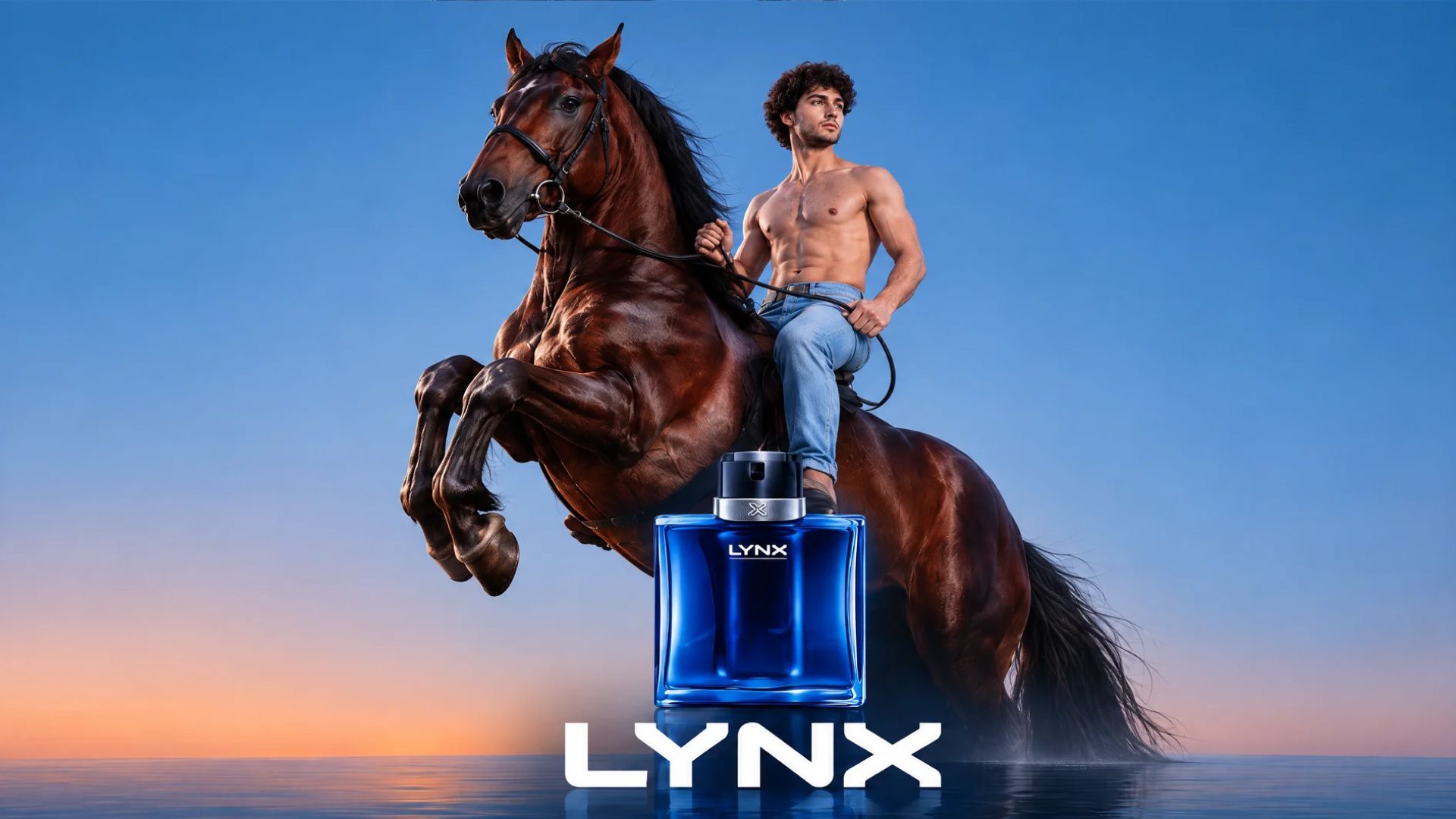
Lynx’s new campaign sends up luxury perfume advertising, so its films needed the genre’s biggest shots: a man floating in open sky, a waterfall crashing over him, and a rider on a rearing horse. Built the usual way, each one is its own production.

Vertex CGI, a global creative production company specializing in viral, social-first campaigns, was commissioned through the agency LOLA Madrid to make the films for Unilever’s Lynx. The campaign would run on screens across the UK: in underpasses, on the street, and in the London Underground.

The idea

The product at the center of the campaign is the Lynx Holder, an ornate perfume-style bottle made to hold an ordinary can of Lynx. Each of Vertex’s three films has two scenes that loop into each other: the luxury fantasy, then what looks like the studio setup behind it. Green-suited figures hold the floating man aloft, the rearing horse turns into a piggyback, and the waterfall turns out to be a garden hose on a stepladder.

The reveal is staged as well. The green-suited figures and the green-screen studio setup around them were both generated, so what looks like behind-the-scenes footage is part of the joke. In every reveal, an ordinary Lynx can also rise out of the Holder. The message, as Vertex puts it, is that you can feel great and confident using a can of Lynx. The end card says it outright: “A luxury fragrance without the luxury price.” LOLA Madrid brought the initial creative direction, and Vertex developed the concepts in detail. That work stayed human-led, with the team shaping the visual metaphors, emotions, and imagery for the intended audience and AI supporting the execution.

[Optional second clip] One of Vertex’s three Lynx films on a London Underground screen.

How it was built

Vertex describes the brief as a standard client task. It ran the job through its Creative Engineering approach, and that started with people. The studio cast three actors, filmed them in a studio with a camera operator and an assistant, and secured their usage rights for the project. Vertex calls those rights important to many brands right now.

The AI image and video work all ran in Higgsfield. The team first generated the original compositions, the imagined environments, and the green-suited figures, then the matching green-screen studio setups. A second model refined each image one at a time, fixing faces, limbs, and other details without changing the intended look, and handled targeted corrections such as an actor’s expression or position.

On the video side, the priority was preserving the looping movement as the setting changed. The team first generated a base video that established the loop, then refined that footage to add detail and keep faces consistent. Next, another model took the refined video together with a still of the green-screen setup and applied the alternate setting while keeping the motion already in place. A final enhancement pass improved detail and sharpness.

The water shows why generation suited this brief. A waterfall like this one would normally mean a built set or a heavy CG simulation, and the shot didn’t need that level of control. For the background footage in that film, Vertex used a separate model that handled the waterfall’s movement best.

“For this task, good-quality generated water was all we needed. We didn’t even have to control it that critically. But here it really delivered: it worked exactly as needed.”

Nikita Vantorin, Co-founder and Creative Director, Vertex CGI

The horse went the same way. Vertex generated it rather than bring an animal to set and teach the actor to ride.

The products

The AI image and video workflow lived on a single Higgsfield Canvas. Having the models it needed in one place gave Vertex the flexibility to test different approaches and combine models to suit each task. The project canvas, Cinema Studio folders, and the image grid kept assets and iterations organized, which made the project easier to manage through development.

The result

Vertex delivered 3 films and 6 scenes in about 5 weeks, not counting feedback and communication delays. About 2.5 weeks went to preparation, testing, casting, and the studio shoot, and about 2.5 weeks to post-production, including the AI production, color correction, and finishing. The project involved 12 people: 5 on the shoot, and a post-production team of 7 that included a producer, creative contributors, AI engineers, and artists. The films ran on screens across the UK, including Knightsbridge, Euston, Waterloo, Victoria, and Charing Cross stations on the London Underground.

For brand and agency teams producing out-of-home campaigns, the split is the model: real performers in front of the camera, and generation for the settings that would otherwise need sets or simulations. Vertex got the visual metaphor it set out to make, with no waterfall set, no real horse, and no riding lessons.

by Higgsfield

Create at the speed of culture.

Built for teams that ship constantly. Here's what enterprise adds:

  • Unlimited users with centralized usage & credits
  • Shared workspaces & asset libraries
  • Dedicated partner manager
  • SSO & security review

More case studies

Show all