Creator Hub
Back

Inside Higgsfield #3: How We Built Higgsfield Originals

Higgsfield
10 mins

“Stories about how we build our products, told by the people who create them.”

Higgsfield Originals is our collection of films and series made with generative AI. Behind it is a team of filmmakers learning how to work with a new medium, and helping shape the tools as they go. Their first series arrived in March 2026. By May, they were in Cannes with a feature. Between those milestones were problems with acting, staging, and production that couldn't be solved by generating more footage alone. Here is how it happened, from the inside.

The Feature We Hadn't Planned

By April 2026, we had our second series, Hell Grind. Then an opportunity came up to present our work in Cannes. We didn't have a feature ready, but we did have an episode to build on.

“We really wanted to get to Cannes”

Adilet Abish, Creative Director of Cinematic Production at Higgsfield

Ziya Rupatov, our Product Marketing Creative Director, remembers the choice as practical. Hell Grind was the most recent Originals project and the longest piece of material we had. Rather than start another film, the team decided to extend it.

A few months earlier, we were still bringing together the people who would make that possible.

Most of our creative team, Ziya included, had worked in short form. They knew music videos, commercials, and individual cinematic sequences. Longer films and series required people who understood how to build stories that could hold together beyond a few minutes.

Adilet became the first targeted hire for that work in February. He had spent years directing music videos and commercials and was gradually moving into films. AI interested him, but stepping away from an established production environment wasn't an obvious decision.

“That door was probably slightly open, but it was scary to step inside”
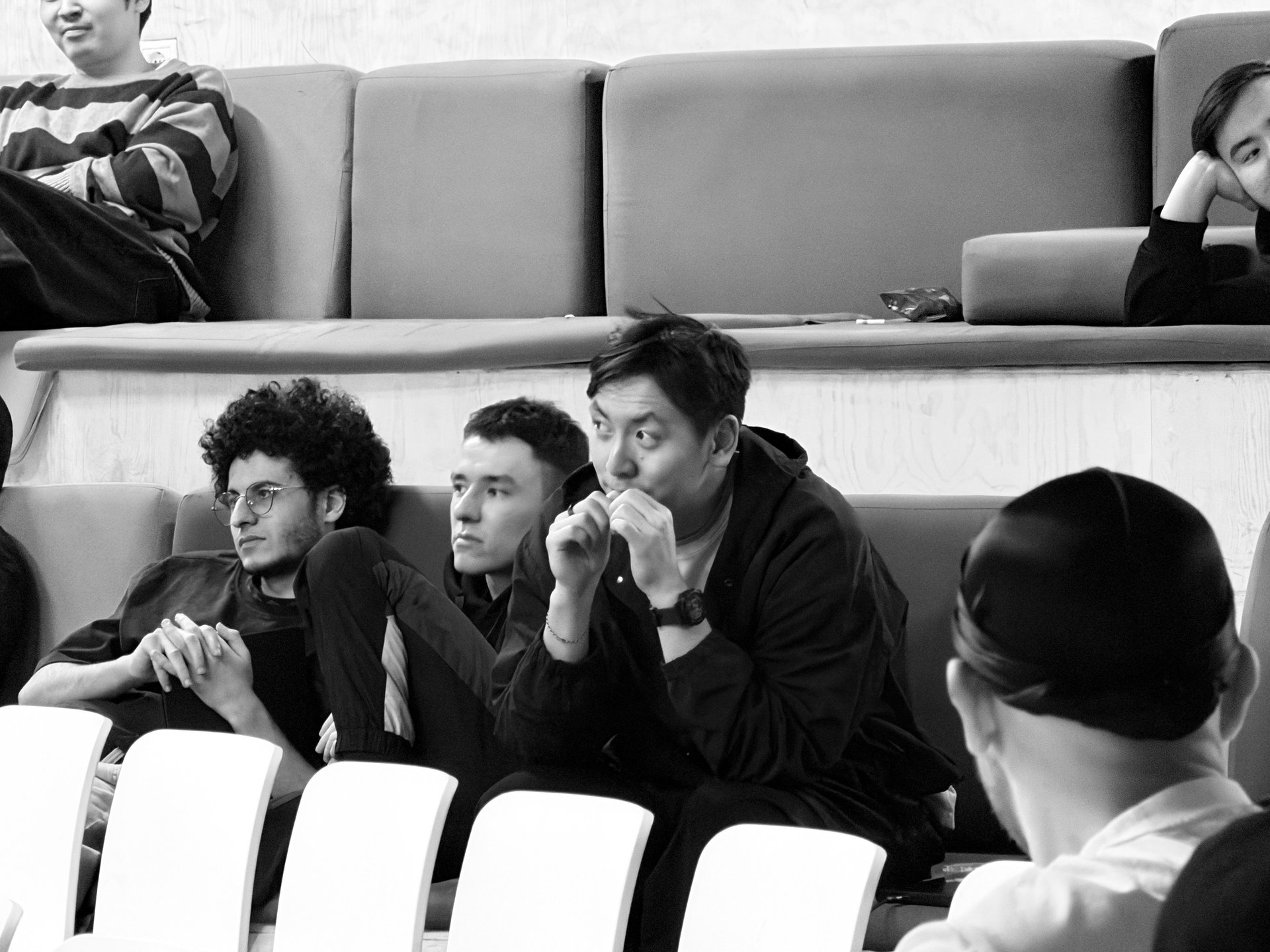
Adilet Abish, Creative Director of Cinematic Production at Higgsfield

He could see the industry changing and wanted to understand where it was going, especially how the creative profession itself might evolve. He wanted to be part of that development rather than watch it happen from outside.

Ziya brought a different kind of experience. At Ozen, the Kazakhstani music label, he had worked across artist management, design, directing, and editing, often because there weren't enough resources for separate people to handle each job.

“The target audience is the general viewer, without question.”

Ziya Rupatov, Product Marketing Creative Director at Higgsfield

For years, he had wondered whether not committing to one discipline had been a mistake. At Higgsfield, that accumulated experience became useful on the team's first release.

Adilet joined other early filmmakers, including Aitore Zholdaskali, who directed the first series, Arena Zero. Ziya remembers the arrival of Seedance 2.0 as the turning point: the technology had advanced, and the team needed to understand what it could now do. Much of the company's work in other directions paused, he recalls, while the filmmakers concentrated on learning the model.

Their first two weeks were spent studying it. Four people worked on Arena Zero, a ten-minute sci-fi episode that became the first series when Higgsfield Originals launched in March 2026.

Hell Grind followed in April.

By May, Ziya and Adilet were in Cannes with a 95-minute feature, presented during the Marché du Film, outside the Cannes Film Festival's official program.

For Adilet, arriving with a film his team had made was a milestone. But getting there had taught the team something that would matter far beyond that screening: making a convincing shot was only the beginning.

The Hard Part Was Making Them Act

A character could look convincing in one shot and become a different person in the next. Faces changed, voices drifted, and locations could lose their consistency when the camera moved. Across a feature-length film, those problems became harder to work around.

But getting the characters to look consistent was only part of the challenge. They also had to act.

Adilet remembers the early problems being solved in stages.

First came basic acting and blocking: where a character stands, how they move, and how the action is arranged within a scene. Once those fundamentals became more reliable, the filmmakers could move into detailed performances and complicated staging.

Physical contact was particularly difficult. A character might look convincing until they reached for an object or interacted with something in the environment. Those moments could break the illusion, even when the rest of the shot looked right.

The team approached these problems one at a time. What they learned on each production gradually became part of the Cinematic team's internal working standard.

Hell Grind also taught the filmmakers how much preparation a single generated shot could require. Character and location references had to be established before production, while prompts needed to describe the camera, lighting, movement, surroundings, and details that should remain consistent with earlier shots.

The prompts became unusually detailed. The team learned to make adjustments deliberately, changing one thing at a time instead of rewriting everything whenever a generation failed. If a complicated shot still wouldn't work, simplifying the action or breaking it into smaller shots could be more effective.

Faces and voices, which had caused problems at the beginning, became more manageable as the team developed these methods.

By the time of our interview, Adilet described the shift in how the filmmakers approached difficult scenes:

“We no longer complain that something is impossible, because everything is possible now. What matters is how you execute the idea.”

Adilet Abish, Creative Director of Cinematic Production at Higgsfield

The work didn't end with generating footage.

Higgsfield's composers and sound engineers handled sound cleanup, music, and other audio production. Ziya describes their approach as predominantly traditional, with generative tools used alongside it. Some compositions were written in-house, while other music and soundtracks were licensed.

The filmmakers still had to choose which shots worked, how performances came together, and whether the finished sequence communicated what the script intended.

All of this was happening while the technology continued to change. Adilet explains that production needed to move quickly because the tools themselves could become outdated before a film was finished.

That meant dividing the work into clear responsibilities so different people could concentrate on their part of the production.

As the films grew longer and more complex, one responsibility became important enough to need a dedicated person.

Nine Directors, One Film

The Cully Hill Boys began with a search for the right story.

Most of our early Originals ideas came from internal pitch sessions. Directors divided into groups, presented their concepts, and developed them through feedback from senior filmmakers. This time, the team found an existing screenplay by Timothy W. Planagan through The Black List.

The story followed three struggling East London rappers whose attempt to shoot a music video unravels after they steal a boat carrying loot and get caught between rival crime syndicates. The team read the script, saw that it could work, and acquired the rights to adapt it into an AI film.

The production also brought real-world talent into the process. Israel Adesanya, Quinton “Rampage” Jackson, N3on, and Matt Kiatipis appeared as digital characters using their licensed likenesses and voices. Before production, each reviewed and approved the screenplay and their character profile, then supplied photographs and voice recordings. Their agreements were limited to this film.

The performances would be generated, but the story, characters, and permissions had to be established first.

Inside the production team, another change was taking shape.

After Arena Zero and Hell Grind, Ziya says, the filmmakers realized they needed someone dedicated to creating and organizing character, location, and prop sheets. These references couldn't remain scattered across individual directors' files. Everyone working on the same film needed access to the same material.

On The Cully Hill Boys, the team formalized that responsibility into an asset-manager role.

The production generated more than 1,000 custom digital assets. A dedicated asset department brought together costume and production designers, generative artists, and editors working on visual consistency.

Nine directors worked simultaneously across different sequences under Aitore Zholdaskali and Adilet Abish. A lead director maintained the overall tone and creative direction, while generative directors handled their assigned scenes. Screenwriters, editors, and post-production specialists worked across the production.

The challenge wasn't simply creating more images. It was making sure that characters, locations, and props remained recognizable when different people worked on different parts of the film.

For that, the team needed shared references and a production process everyone could follow.

The Cully Hill Boys premiered at a private industry screening at The Glasshouse in New York on August 5, 2026. The 110-minute feature was produced in four weeks by a 28-person team on a $2 million budget.

Behind those figures was something the earlier productions had helped the team develop: a clearer division of responsibilities, dedicated asset preparation, and a more structured way of making a film together.

Those needs didn't just change how our filmmakers worked. They also began influencing the products they used.

The Product Team Moved In

For a while, Adilet remembers, the Cinema Studio product team actually sat in the filmmakers' office.

The people building the tools could see how the Cinematic team used them during production. Feedback wasn't something collected only after a film was finished. It came directly from the work happening around them.

“Right now all of Cinema Studio is built on the Cinematic team's feedback.”

Ziya Rupatov, Product Marketing Creative Director at Higgsfield

Cinema Studio existed before Originals, but making longer films brought different demands. Filmmakers needed more than control over individual shots. They had to plan entire sequences, manage references, and maintain a consistent visual direction across scenes produced by different people.

Those production needs became part of the ongoing feedback between the filmmakers and product teams.

We explored the earlier development of the product in Inside Higgsfield #1: How We Built Cinema Studio.

Canvas is another example of how the filmmaking workflow influenced our tools.

During pre-production, the Cinematic team uses Canvas to organize characters, locations, props, and other materials needed for a film. Ziya describes it as a shared library that filmmakers can return to throughout production.

But organizing those assets was only half the job. Directors also needed to bring them into the scenes they were generating.

That's why Canvas can be opened directly from a Cinema Studio project. The filmmakers can prepare their references during pre-production, then use that same material when they move into generation.

The team also works with agentic systems, including Supercomputer, alongside traditional production software such as Photoshop, DaVinci Resolve, and Premiere Pro. We covered how that agentic workspace was developed in Inside Higgsfield #2: How We Built Supercomputer.

For Adilet, the larger ambition is to make the long-form filmmaking process something other creators can learn from and use.

The Cinematic team makes films with our tools, discovers what needs to work differently, and brings that experience back to the people building them. Each production gives the team another opportunity to improve its methods.

And those lessons aren't meant to stay inside the company. The next step is showing other filmmakers how the work was actually done.

Even the Blurry Posters Mattered

While reviewing submissions to the Higgsfield Global Film Festival, Ziya and the team found themselves looking closely at posters on a wall behind a character.

The posters were out of focus. They weren't the main subject of the shot. But the filmmaker had carefully designed them, hiding small references and easter eggs inside the scene.

For Ziya, those details made the world more interesting. Someone had thought about what existed beyond the main action, even in places the audience might barely notice.

“Everything has become automated, but the human touch at that level has to be present and remain.”

Ziya Rupatov, Product Marketing Creative Director at Higgsfield

That attention to detail is something Ziya believes filmmakers coming into AI should learn from traditional cinema. Generating an image is one thing. Building a world that feels considered, down to its smallest details, is another.

It's also why we want to share more than finished films.

The Hell Grind project includes production materials that let creators explore the references, prompts, and methods behind the film. For The Cully Hill Boys, we also committed to sharing the production workflow through Higgsfield Academy, including how the team approached preparation, prompting, and asset management.

The materials available for reuse depend on each project's license. Some Originals builds are released under Open Works licenses that permit reuse under specific conditions. Others are more restricted. The Cully Hill Boys has a study-only license, reflecting the use of real performers' licensed likenesses.

The goal is to make the filmmaking process understandable, so creators can learn from the work and develop their own approaches.

Adilet sees sharing that knowledge as part of helping an AI filmmaking industry take shape. Rather than keeping the team's methods internal, he wants more filmmakers to understand how longer-form productions can be made.

For Ziya, the larger ambition goes beyond production itself. He describes Higgsfield as a platform that can support the full creative cycle, from making content to helping creators develop and eventually distribute their work.

“Full cycle. The future of entertainment.”

Ziya Rupatov, Product Marketing Creative Director at Higgsfield

But Originals isn't being made only for people who understand AI models or want to study how each shot was generated.

Asked who the films are for, Ziya is clear: 

“A broad audience, definitely.”

Ziya Rupatov, Product Marketing Creative Director at Higgsfield

That means the story, performances, staging, and details have to matter beyond the technology used to create them. A film still needs to give someone a reason to keep watching.

Originals began with a small team learning a new model. Each production since has added something to the process: new ways to approach acting, dedicated roles for managing assets, and workflows shaped by the filmmakers using them.

Those discoveries feed back into the tools we build and the knowledge we share. Higgsfield remains a technology platform, and Originals is one way we learn what filmmakers need from it.

The finished films are what audiences see. The decisions, experiments, and work behind them are what we want other filmmakers to learn from.

In the next Inside Higgsfield story, we'll go behind the scenes with our cinematographers and follow how an AI film is made, from the very first idea to the final cut.

Inside Higgsfield #3: How We Built Higgsfield Originals

Watch Higgsfield Originals

Got any questions left?

by Higgsfield