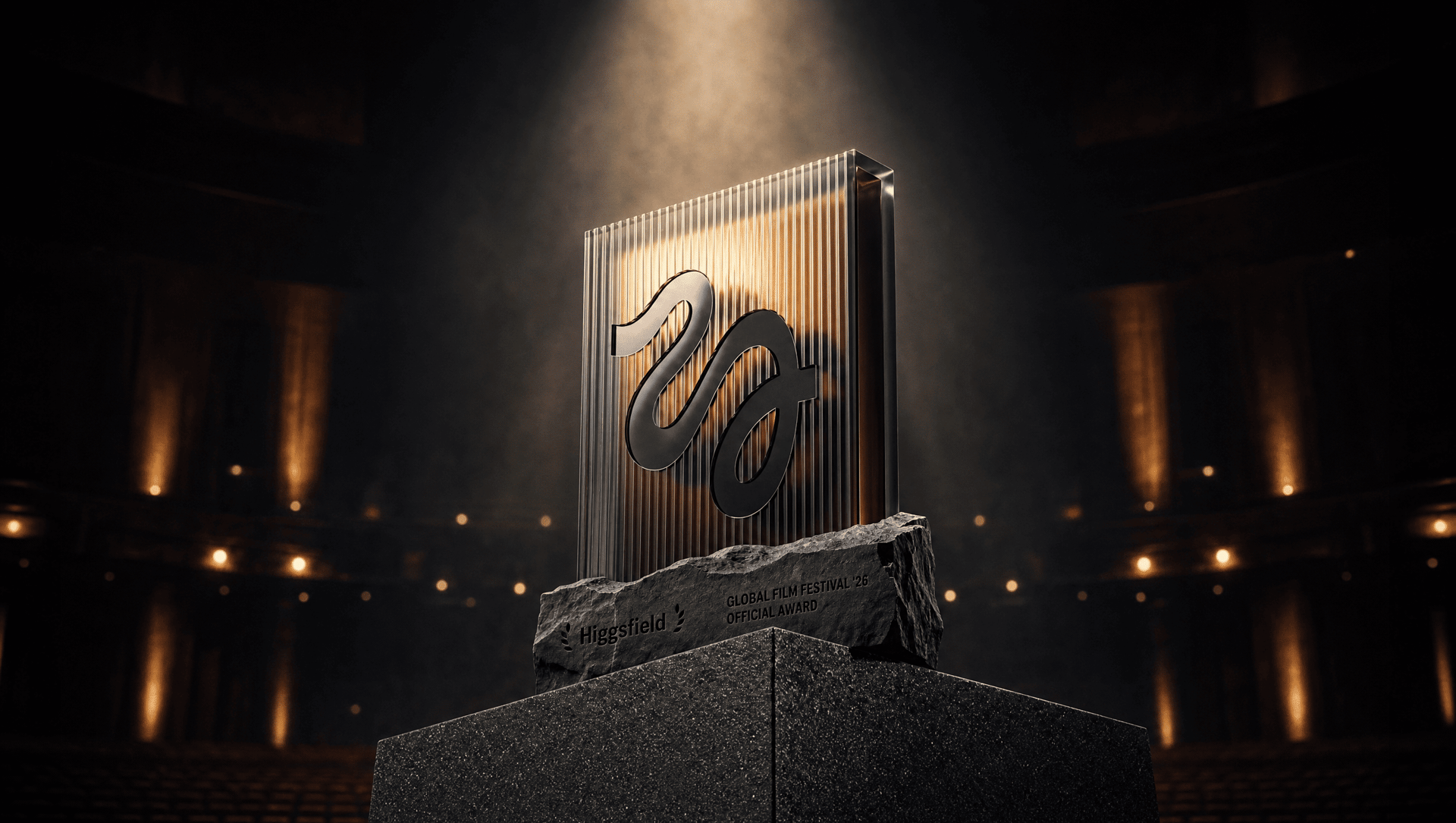
Higgsfield Global Film Festival is now open for submissions. It's a $1,000,000 short film contest made entirely on Higgsfield's platform. Any genre, any style, minimum 3 minutes, solo or in a team of up to four. Submissions close September 15 at 11:59 PM UTC. This guide covers who can enter, how films get made, and how prizes and rights work.
What Is the Higgsfield Global Film Festival
Higgsfield Global Film Festival is the platform's own short film contest, backed by a $1,000,000 cash prize pool. Every film in the competition is generated entirely inside Higgsfield.
Who can enter:
- Anyone 18+ with with a registered Higgsfield account
- Solo or in a team of up to 4, with one Team Leader who owns the project and receives the prize
Format and film requirements:
- Any genre, style, or theme, freeform
- Minimum runtime: 3 minutes, Recommended maximum 5:00 minutes, longer films remain fully eligible
- Unlimited entries per participant or team, but each one has to be a separate, standalone film
- One prize per participant or team, no matter how many films they submit
- Format: 16:9 or 21:9
- Language: Any language, real or fictional, with English subtitles or voice-over.
- Format: MP4 or MOV, up to 4K.
Generation rules:
- All video and image generation happens on higgsfield.ai, any model on the platform counts
- Everything gets built from scratch inside the Generation Window, though previously generated inputs can still be reused as references.
- Inputs can't include a real person's face or voice, not even the participant's own.
Prize Pool: $1,000,000
Prize | Winners | Amount Each |
|---|---|---|
1st Place | 1 | $500,000 |
2nd Place | 1 | $200,000 |
3rd Place | 1 | $100,000 |
Audience Choice Award | 1 | $100,000 |
Honorable Mention | 10 | $10,000 |
Fourteen filmmakers win in total. Track Prizes, the Audience Choice Award, and Honorable Mentions don't stack, one film gets one prize, and one participant or team gets one prize across all their entries.
What You Actually Need to Submit
A film only counts if it clears the Minimal Viable Submission: the final video with Higgsfield's watermark and packshot, and a public post of that same video on Instagram, YouTube, X, or Reddit. The post has to stay public and viewable without logging in, an account that's private or locked disqualifies an otherwise strong entry.
Music, voice, and sound design must be generated using AI tools, as long as the files get uploaded into the submission project and the creator holds the rights to use them.
Timeline
Milestone | Date |
|---|---|
Competition opens | Aug 10, 2026 (Monday) 02:00 PM PT |
Submission deadline | Sep 15, 2026 (Thursday), 11:59 PM UTC |
Screening & shortlist compilation | Sep 16 – Oct 5, 2026 |
Jury review | Oct 6 – Oct 11, 2026 |
Winners announced | End week of October 2026 (exact date to be confirmed) |
Open-Source Reference Projects
Ahead of the competition opening, Higgsfield open-sourced three of its own projects as free reference material. Hell Grind, a story about four street kids who wake an ancient evil in a museum heist gone wrong, and Zephyr, about a squad of heroes defending their city from an alien invasion, are both fully public: every prompt, asset, and generation behind every scene is there to study or build on. Cully Hill Boys, an action-comedy about three underachieving London rappers who accidentally get caught in a messy drug war, is public too.
Each is worth opening before writing a single prompt. They show what a finished, competition-quality project actually looks like inside the platform, not just the final film, but the full path that got there.
How Films Get Judged
Every submission runs through three stages before a winner gets picked.
Screening. Higgsfield checks each entry against the basic requirements: runtime, format, generation history, and whether it's complete. Anything that doesn't clear this stage doesn't move forward.
Shortlist. From what's left, Higgsfield's creative team selects the strongest films against four criteria: directing and storytelling, visual craft, sound and editing, and originality and concept.
Two parallel tracks on the same shortlist. The creative team and an independent jury review the same films, without seeing vote counts, to pick 1st, 2nd, 3rd Place, and the Honorable Mentions.
Who's on the jury. Edwin Catmull, 5-time Oscar winner, former President of Walt Disney Animation Studios, executive producer of Toy Story, and Turing Award laureate, sits on the panel alongside Phedon Papamichael, a 2-time Oscar and BAFTA nominee and ASC member who shot Ford v Ferrari, The Pursuit of Happyness, and The Trial of the Chicago 7. Paul W.S. Anderson rounds out the panel, the director behind Mortal Kombat, the Alien vs. Predator franchise, and the Resident Evil film series, 30 years of box office hits from a director whose work has grossed over a billion dollars.
From Idea to Award
Entering runs in four steps:
1. Shape the idea.
Decide on your concept and, if you're working as a team, lock in who's on it (up to four people, with one Team Leader who owns the project).
2. Build the film.
Generate everything from scratch inside Cinema Studio, where the submission project lives from first generation to final cut. Cut it together, add sound, and finish the film.
3. Submit and post.
Submit the finished video with Higgsfield's watermark, then post that same video publicly on Instagram, YouTube, X, or Reddit before the September 15 deadline.
4. Judging takes over.
From there, screening, shortlisting, and jury review take over, all running on a fixed schedule.
What stays in a filmmaker's control is the film itself. Any genre, any style, solo or with a team, judged on directing, visual craft, sound, and originality rather than follower count or platform history. Fourteen films win a cash prize, and every eligible project, win or not, becomes something the next person entering can open up and learn from.