Blog

AI vs VFX: Can Seedance 2.5 Beat VFX?

Higgsfield
AI vs VFX: Can Seedance 2.5 Beat VFX?

How To Make Realistic VFX Shots With Seedance 2.5

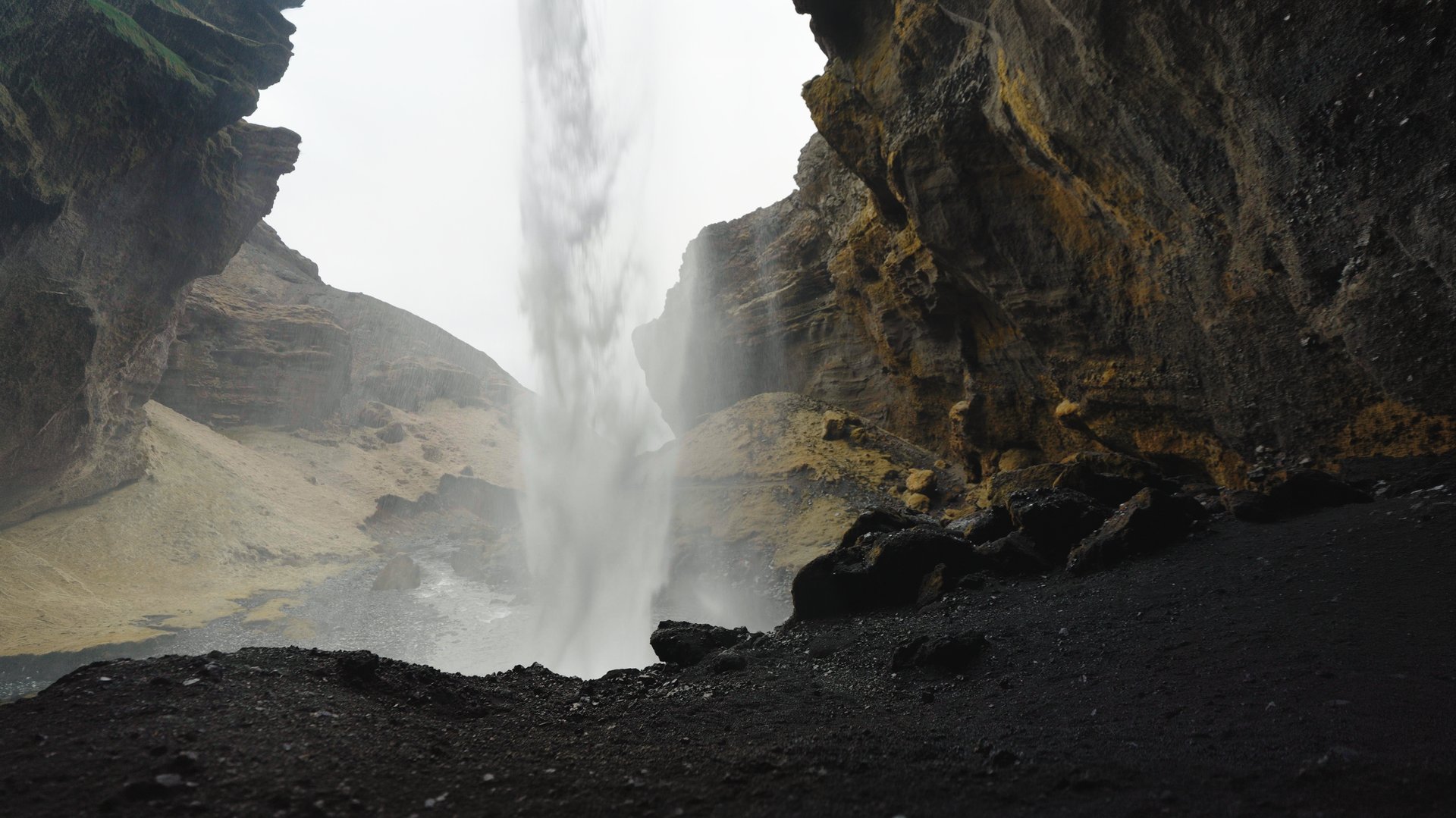
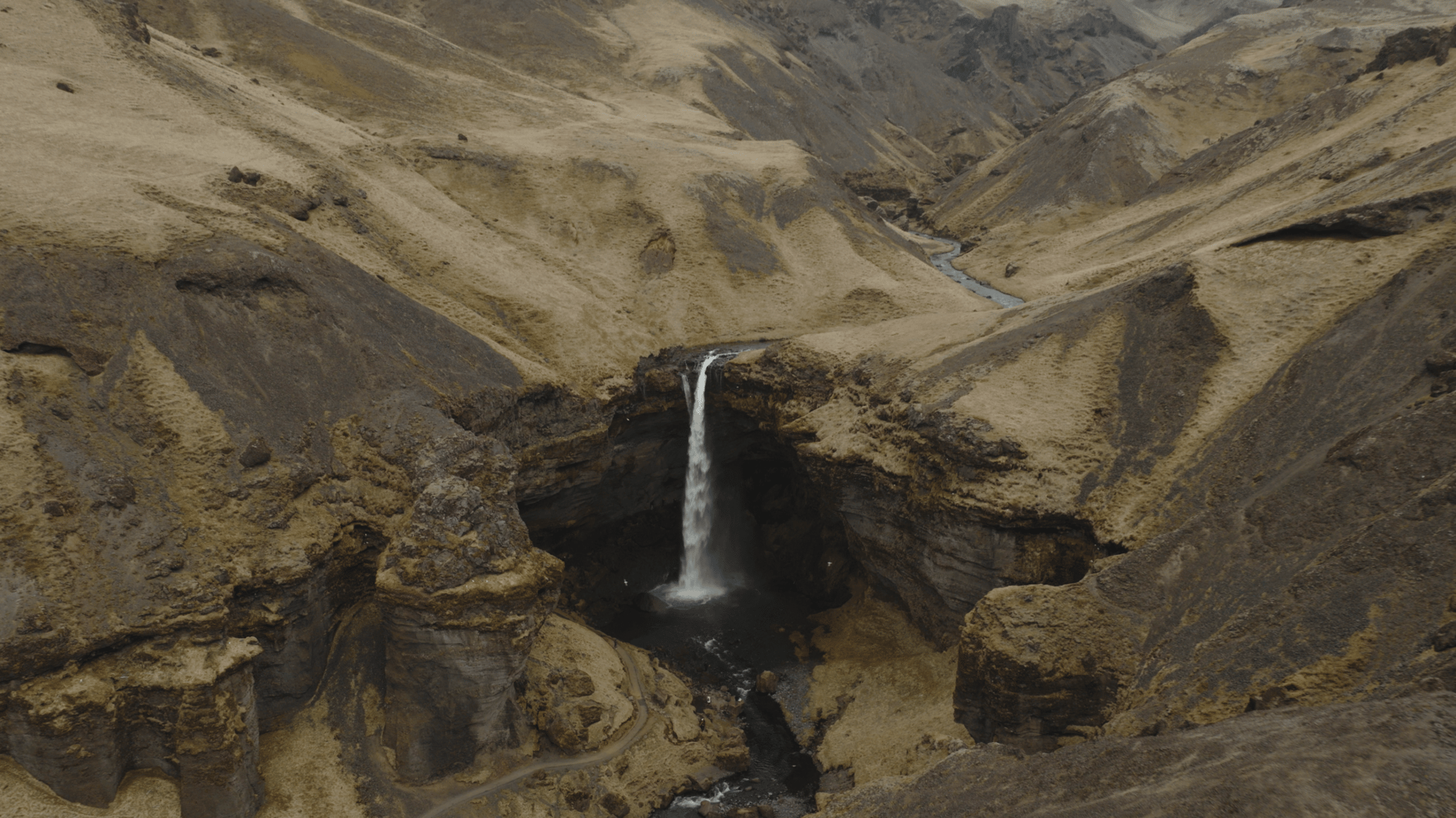
Seedance 2.5 just went live on Higgsfield - it's the most anticipated model of the year, every single shot below was made with it, and there's a special launch offer running while it lasts. We ran a challenge with Erik - the VFX artist behind some of the most viral VFX videos on the internet - to see if AI can actually beat VFX. Same shots, built two ways: he uses the full VFX pipeline - 3D tracking, simulation, compositing - and we use only AI. But the real question behind the challenge isn't about beating anyone. It's this: can AI help VFX artists do their work faster and easier? First, watch what we had to recreate. Erik traveled to Iceland and filmed real footage around a cave - a drone shot toward a waterfall and a few shots inside the cave itself:

The brief: put our host into that cave, make him jump off the cliff onto a dragon, and fly through the waterfall - frame for frame. And then take it one step further: a fully AI-generated cinematic that would cost studios at least $50,000 the traditional way. Here's how we did it, step by step.

Step 1 - The Assets

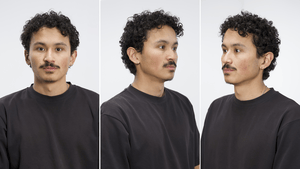
One photo against a wall is enough.

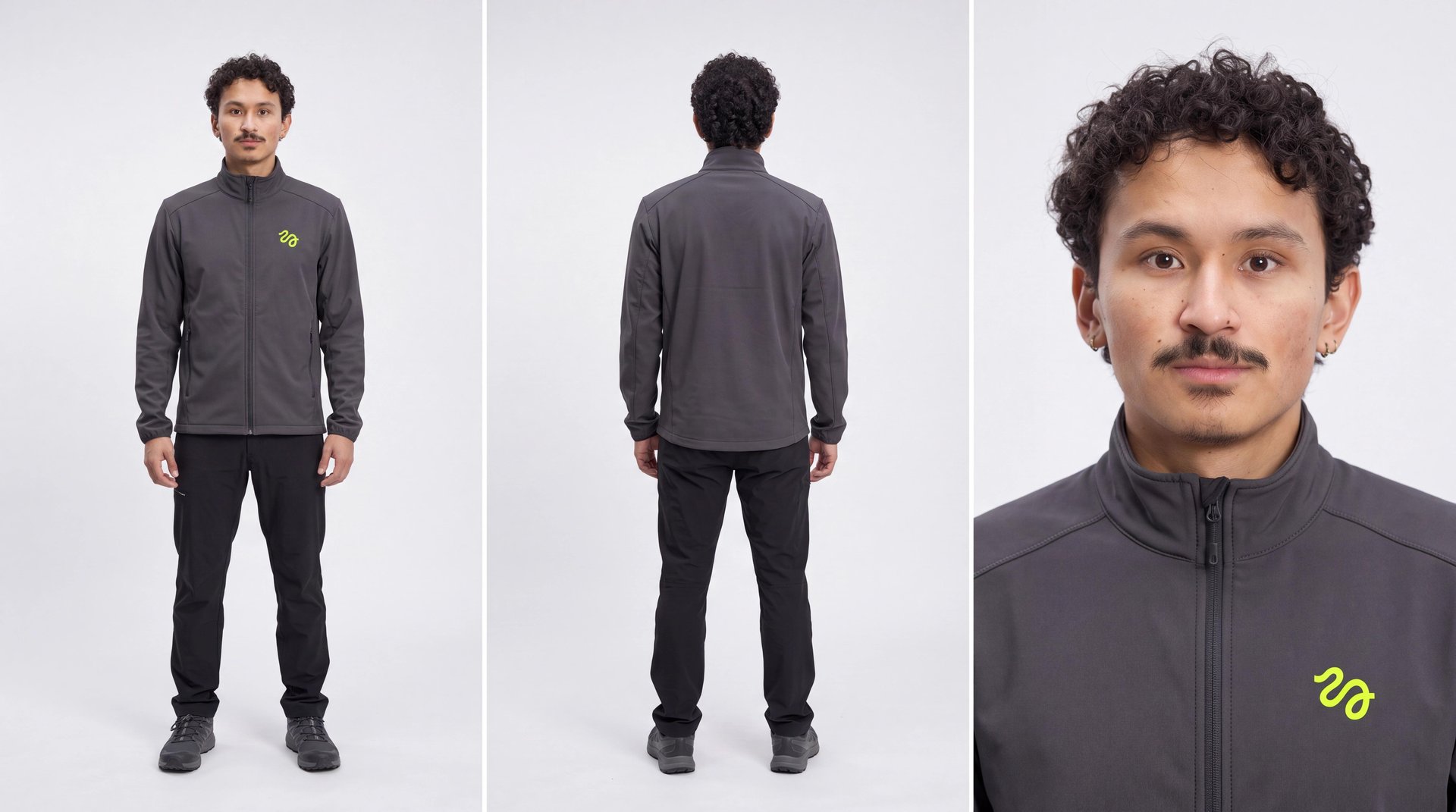
Upload it to Claude, ask for a character sheet on a grey background - full-body front and back plus a close-up - and generate it with Nano Banana 2, the best model at matching faces. And here's the tip that saves you real credits: always generate character sheets on a plain grey background. Keep this workflow in mind, because it runs the whole project: Claude writes the prompts, Higgsfield makes the content. Save this image as an element and name it @adil-hiking

Make me a prompt for a character sheet of me on a grey background from 3 angles: full-body front and back, and one close-up, in hiking gear with the attached logo.

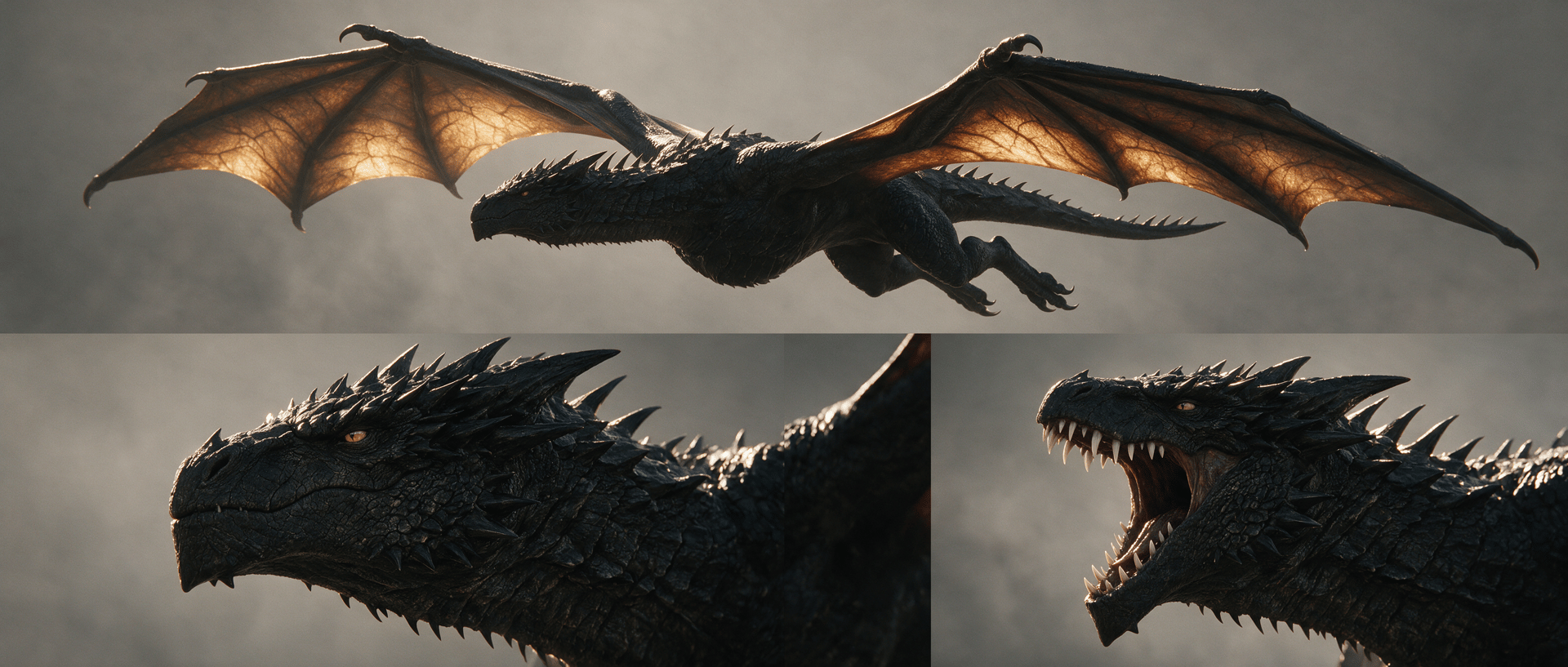
For the dragon, switch the model: Seedream 5.0 is the best at fantasy creatures. One key tip for a creature with this much detail: generate two close-ups - mouth open and mouth closed. That keeps the face from glitching between expressions.

In traditional VFX, this asset alone is a project: you'd sculpt the dragon, do the retopology, unwrap the UVs so the texture fits, then rig it before you could even animate - and only pros with years of experience can pull that off. Buying a model costs real money, and you'd still have to animate it yourself. We made ours in one minute for 40 cents.

Photorealistic character sheet of a colossal black wyvern dragon, 3-panel split screen layout. Panel 1: full body side view in gliding flight, streamlined torpedo-shaped body, long extended neck, charcoal-black rocky scales, long narrow bat-like wings with translucent leathery membranes glowing warm amber when backlit by sun, visible dark veins in wing membranes, muscular hind legs tucked back with long clawed feet, wyvern anatomy with clawed wing fingers, small spikes along spine, long spiked tapering tail. Panel 2: close-up portrait of the head, heavy broad snout, massive powerful jaw, mouth closed, crown of sharp black spikes on top of head and brow ridges, rows of small spikes along the jawline and neck, rough cracked stone-like scale texture, pale amber reptilian eyes, stern cold merciless stare. Panel 3: close-up of the head same angle, jaws stretched wide open in a furious roar, long white curved teeth, dark red mouth interior, spikes bristling on neck. Matte black weathered scales, hyper-detailed skin texture, dramatic side rim lighting, soft neutral grey studio background, cinematic creature VFX quality, shot on ARRI Alexa, 8k

Step 2 - The Video-to-Video Swap

To recreate Erik's footage we use video-to-video: upload the original, make the edits with a prompt. First, cut the source into clips - and if any clip is shorter than four seconds, freeze-frame the last shot: Seedance needs at least 4 seconds of video input for v2v. When you generate, set the duration to four seconds to match the reference - anything longer and the AI starts guessing.

SCENE CONTEXT Video-to-video character replacement. Source clip @video1: a young man framed chest-up, centered against a dark craggy rock wall, frozen in shock with his mouth open; he then drops straight down out of frame in a fast motion-blurred move, and the shot holds on the empty rock wall to the end. Replace the man with the man from @adil-hiking. Everything else stays exactly as in @video1. ACTIVE REFERENCES @video1 — source footage: master for camera, framing, focus, motion, expression timing, background, lighting, grain and duration. @adil-hiking — replacement character: young man, voluminous curly black hair, mustache, small earrings in both ears, charcoal-gray softshell zip-up jacket with a high collar and a small lime-green squiggle logo on the left chest, black trousers. 100% matches the reference. EDIT INSTRUCTION The man from @adil-hiking takes the original man's place and inherits his exact performance frame by frame: same body position and posture, same head angle, same wide-eyed stare and open-mouth shock expression with identical mouth aperture and blink timing, same stillness during the hold, and the same fast straight-down drop out of frame at the exact same frames with matching motion blur. Silhouette scale and screen position match the original at every frame. PHYSICS Curly hair and jacket collar respond naturally to the sudden downward drop, with motion blur identical in direction and intensity to @video1. LIGHTING Identical to @video1: dim low-key light on the face against the dark rock wall, same exposure, same white balance, matched frame for frame. WARDROBE Charcoal-gray softshell zip-up jacket with the small lime-green squiggle logo on the left chest, black trousers — 100% matching @adil-hiking. STYLE Photoreal, seamless integration into the source plate: grain, motion blur, focus falloff, compression character and color match @video1 so the replaced man is indistinguishable from originally shot footage. POSITIVE LOCKS Camera behavior, framing and focus identical to @video1 for the full duration, one continuous shot. The rock wall background and every pixel outside the replaced man remain exactly as in @video1, including the empty-wall ending. Duration and all action timing unchanged. Only the man is replaced; his face, hair, mustache, earrings and jacket logo stay 100% consistent with @adil-hiking in every frame he is visible.

The AI matched the lighting and contrast to the environment automatically - pause mid-action and the frame is still crisp. In traditional VFX this shot needs a compositor: keying (curly hair is a nightmare - every stray hair cleaned by hand), then despilling the green reflection off the skin, then compositing the actor into the scene and matching light, shadows and film grain. That's hours, even for a pro - and it's exactly the step AI now does under the hood.


Step 3 - The Jump

The dragon-catch shot failed across all four batches - and that's the lesson: there's no actual jump moment in the source, so v2v turns it into slop. If the same problem shows up in all four batches, the issue is the prompt or the source material. Batching further just burns credits. The fix: switch to image-to-video - take a screenshot of the location, use it as the starting frame, and stitch the two shots in the edit. Notice the empty-frame pause written into the prompt: 1.5 seconds of nothing but waterfall - that's your cut point.

Use @location-frame as the starting frame: the empty waterfall canyon — massive vertical waterfall, dark volcanic cliffs, black rocky ledge in the right foreground, cold grey light and drifting mist — stays unchanged throughout, static camera. @adil-hiking from the character sheet — same face, curly dark hair, mustache, grey zip-up jacket with green logo, black pants — runs into frame from the right at full sprint and leaps off the cliff edge in a flat belly-first jump — body horizontal, chest and stomach facing down, arms and legs spread out — falling fast with real gravity, disappearing below the ledge. Then a pause: for about 1.5 seconds the frame stays completely empty, only the waterfall and drifting mist. Suddenly @dragon-v3 bursts up from the abyss seen from behind, head pointed at the waterfall, with Adil already on its back between the neck spikes, and flies straight into the waterfall — water explodes around its body and wings in heavy spray and mist as the dragon plunges through the falling water and vanishes inside it. The shot ends as the dragon disappears into the waterfall. Fast real-time action, no slow motion, natural motion blur, cinematic realism, realistic water simulation, no camera movement, no cuts.

To pull off this jump the traditional way, you'd build a full CG double: cloth simulation, physics, body-mass and trajectory calculations - all for a two-second shot, plus rotoscoping the midground. It's a huge grind, and it's exactly the kind of work pros like Erik do. And CG doubles are where the viewer's eye catches the fake: there are only two ways a person goes off a cliff - you step off vertically, feet first, or you push off and dive. When a digital double tips over in a stiff "soldier" pose and slides down at one constant speed, with nothing moving in the clothes - that's not a person falling, that's an asset being dragged from point A to point B. Your eye catches it even if you can't name it.


Step 4 - The Burst

Use @video1 as the unchanged background plate — keep it exactly as it is, frame by frame: same camera orbit, same overcast diffuse lighting, same mist, same colors. Do not add any sun, sunlight, glow or lighting effects. Do not change the environment in any way. Add the black spiked dragon from @dragon-v3 flying out of the waterfall mist, with the rider from @adil-hiking lying flat on the dragon's back — the rider is tiny compared to the enormous dragon, barely visible, lying face-down along the dragon's spine, body flattened against its back, arms wrapped around it, holding on tightly. Right after bursting out of the water, the dragon shakes off like a wet animal: its head rapidly rotates back and forth around its own axis — a twisting rotational shake, like a dog shaking water off — and the twist travels down the neck as a spiral wave, the loose skin and neck spikes wobbling with the rotation, flinging spray outward in a spinning radial cloud. Then it settles into serpentine flight. Serpentine flight at natural real-time speed — not slow motion. The dragon's entire body undulates like a worm swimming through the air: with every wingbeat a wave of motion travels along its spine — the chest lifts, then the wave rolls through the belly, hips and down the tail. The neck and torso flex and curve continuously, never rigid, the whole silhouette constantly S-curving and rippling. The head moves independently; the legs sway loosely under the rolling body; the long tail carries the body wave through to its tip. Powerful wingbeats drive each body wave — raw, animalistic, fluid snake-like motion. The dragon itself stays completely dry at all times — its black scales remain matte and dry even though it flies through mist and heavy spray; the water and mist swirl around it in the air but never soak or wet its body. It flies away from the camera deeper into the canyon, following the direction of the camera pan, shrinking into the atmospheric haze. Photorealistic creature animation, real-time speed, cinematic, 4K.
In traditional VFX, realistic creature movement has its own anatomy you have to recreate: build a 3D scene, match the lighting, animate every part of the rig - down to the scales. Just animating the dragon could take weeks, and the standard 3D software alone costs up to $3,000 a year. Here it's a rewrite and a generation.


Step 5

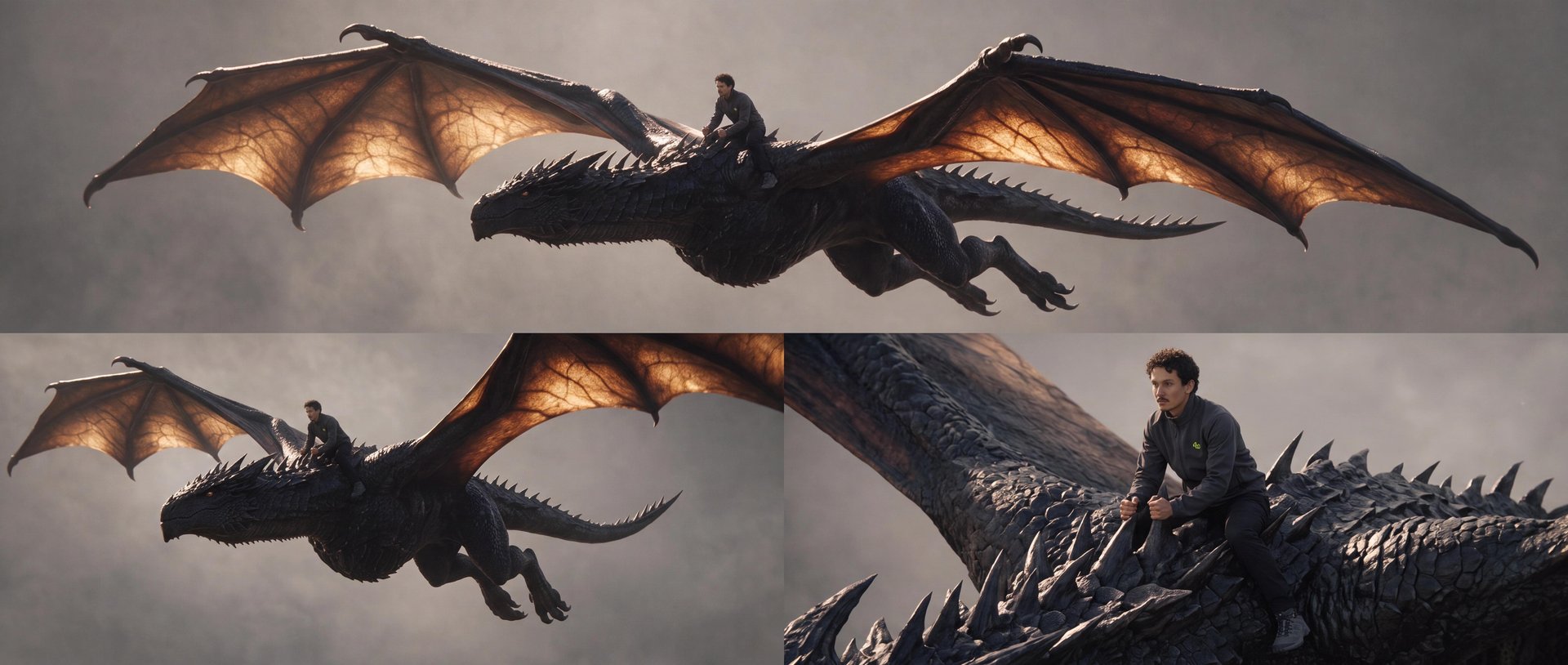
The fix is a size-ref frame: one image that locks your exact scale on the dragon, saved as its own asset and attached to every scene. Build it by combining the dragon sheet, your sheet and a screenshot from a good previous shot:

Professional film production character reference sheet combining the three provided references into one mounted pair: the black dragon from the dragon reference, ridden by the man whose face exactly matches the face reference and whose outfit exactly matches the full-body hiking reference. Three frames on a neutral misty grey studio backdrop: one wide panel across the top, two square panels along the bottom. Soft directional studio light with a gentle backlight, so the wing membranes glow translucent amber. The dragon is exactly the dragon from its reference — obsidian-black scales, rows of black spikes along skull, neck and spine, amber-gold eyes, translucent amber wing membranes with dark veining. The rider's face is an exact match to the face reference — same black curly hair and hairline, thin mustache, small chin patch, brown eyes, beauty marks in the same positions, small silver hoop earrings in both ears. His outfit comes from the full-body reference — charcoal-grey softshell zip jacket, zipped up, with a small lime-green squiggle logo on the left chest, black hiking trousers, grey hiking shoes. The same dragon and the same rider in all three frames, consistent across panels. TOP PANEL — full side view of the dragon in mid-flight glide, wings fully spread, the rider seated at the base of the neck between two dorsal spikes, leaning forward, both hands gripping the spike in front of him. True scale: wingspan as wide as twenty humans lying head to toe; the dragon's head alone is longer than the rider's entire body; the seated rider stands no taller than half of one neck-base spike — a small figure against the vast neck. BOTTOM LEFT — three-quarter front view of the dragon in flight coming toward camera, wings mid-downstroke, the rider visible low against the neck in the same seated position, small against the bulk of the dragon. BOTTOM RIGHT — close-up of the mounting point: the rider seated between the neck-base spikes, grip and posture visible, his face clearly readable and an exact match to the face reference, each dragon scale around him as large as the rider's head. Cinematic film still quality, photoreal creature and human detail, fabric texture, scale texture and skin all sharp and true to life, fine film grain, consistent lighting across all three frames.

Then regenerate the flyby with the scale law attached - and keep the camera shake and lens droplets the prompt asks for at the end. That's what makes it read like a real drone:

@video1: 6s drone shot, slow forward push-in with a subtle left pan toward a single-drop plunge waterfall in a dark basalt amphitheater; mossy volcanic rocks foreground right, shallow stream left, narrow dirt footpath midground, overcast diffused daylight, light mist at the base. The output must be the SAME footage as @video1 — the identical canyon, waterfall, rock shapes, stream and footpath, frame-locked to the original plate and its camera push-in; never redesign, restyle or re-imagine the environment. One single continuous full-frame shot: NO split screen, NO picture-in-picture, NO insets, NO panels. Add only the dragon and its rider — exactly ONE dragon and ONE rider in the entire shot. @adil-hiking: The rider. Identity, face, hair and full hiking wardrobe exactly as in the reference; slim regular hiker's build — lean, not muscular; ignore the sheet's white studio background. His face must stay identical to this reference in every frame. Do NOT enlarge the rider — he stays a normal-sized man. @dragon-v3: The dragon. Appearance, scale texture, dorsal spikes, translucent amber wing membranes and anatomy exactly as in the reference; ignore the reference background and lighting. @size-ref: Single image of the same rider mounted on the same dragon in flight — this is the exact rider-to-dragon proportion to reproduce: the dragon is colossal, body length about 12x and wingspan about 14x the rider's height, the rider a tiny figure mounted low on the shoulders at the base of the neck. Match this proportion in every frame. Ignore this image's background, lighting and grade. Photoreal. 16:9. 6s. 4K. Cold overcast Icelandic grade matching the source plate. NON-IP — generic dragon design, not based on any brand or character. SFX only. Continuous shot, same framing and the same slow drone push-in as the source. From the first frame @dragon-v3 is airborne DEEP in the background, far away against the waterfall's rock face at the height of its top lip — small in frame at first — flying head-on straight at the camera with @adil-hiking mounted low on its shoulders exactly as in @size-ref, the colossal proportions held consistent in every frame. Its flight is VERY FAST: in the first 1.5 seconds it drives forward with rapid, deep, forceful wingbeats — each downstroke visibly hurling it toward the camera — then it locks into a high-speed glide: wings fully extended, level and slightly cupped, front claws tucked against its chest, hind legs trailing, the long tail making small rudder corrections. It devours the length of the canyon, holding a dead-straight line down the center toward the lens — no banking, no sideways drift, frontal silhouette — dipping gradually lower over the stream, swelling in frame faster and faster with aggressive closing speed; its flight path stays clearly ABOVE the camera's height at all times, aimed directly over the top of the lens, never off to either side. Fully photoreal creature: real wet glistening scale detail with depth, individual dorsal spikes, translucent membrane wings with veins catching the flat grey skylight and rippling hard in the slipstream, true reptilian anatomy — never CG, plastic or cartoonish. NO steam, NO smoke, NO breath vapor, NO mist trailing from the dragon — its body is clean and sharp against the scene. Living micro-motion: nostrils flare, pale eyes locked ahead, muscles slide under the hide. @adil-hiking is a living, breathing, constantly moving rider — never static, never mannequin-like: pressed low against the rushing wind, torso rocking with every jolt of the glide, shoulders working, small head turns, chest heaving with adrenaline breaths, wet curls and jacket collar whipping. He is damp from the waterfall spray — wet curls clinging to his forehead, fine droplets on his face, jacket darkened with moisture and beaded with water. His face plays a real reaction arc — eyes wide with adrenaline, an incredulous breathless grin breaking through a squint, a quick nervous laugh snatched by the wind, knuckles white on the dorsal spike — natural human micro-reactions, his face and identity locked to @adil-hiking and unchanged throughout. Both are lit by the same soft diffused overcast key as the plate, cool skylight from above, a soft contact shadow racing along the stream banks beneath the dragon. At about 4 seconds the colossal dragon rockets directly OVER the top of the camera with clear height margin — its chest, belly and wing membranes ripping overhead across the ENTIRE upper frame with heavy motion blur, the camera tilting up slightly to follow the belly, the spiked tail clearing the lens last; it passes overhead, never to the side, and never intersects, touches or passes through the camera. THEN THE SHAKE — this beat is mandatory and must dominate the final 1.5 seconds, from about 4.5s to 6s: the pressure wake of the giant body slams the camera and it SHAKES VIOLENTLY — the whole frame jolts downward then snaps back, the horizon visibly tilts a few degrees side to side, three-four fast sharp oscillations with heavy motion blur and rotational jitter, the framing visibly displaced several percent on each hit, then the shake decays into loose handheld wobbles by the last frames while the empty canyon settles back into view. Simultaneously the wake slams a burst of waterfall spray into the camera: distinct water droplets splatter onto the lens glass and STAY there — beads and small streaks refracting the scene like a wet GoPro, trembling and creeping with each oscillation of the shake. Environment, waterfall, lighting and grade identical to the source throughout. SFX only: constant waterfall roar and stream trickle; rapid heavy leathery wingbeats building from distant to massive, then a rising howl of glide wind; a faint whooping laugh torn by the wind; a violent whoosh and deep pressure thump as it rockets overhead at ~4s; wet spray splattering across the lens and a hard rattling rumble under the violent camera shake from 4.5s to the end.

Part 2 - The $50,000 Cinematic

No real footage at all this time - the whole scene is generated. The pipeline is the same - images first, then video - so here are just the new tricks, scene by scene.

Generate with GPT Image 2, then learn to spot slop: a warped logo, a blue-ish color shift. For small fixes don't write a big prompt - switch to Nano Banana 2 (the model that holds inputs best) and write one line:

The new sheet - and the face-lock trick:

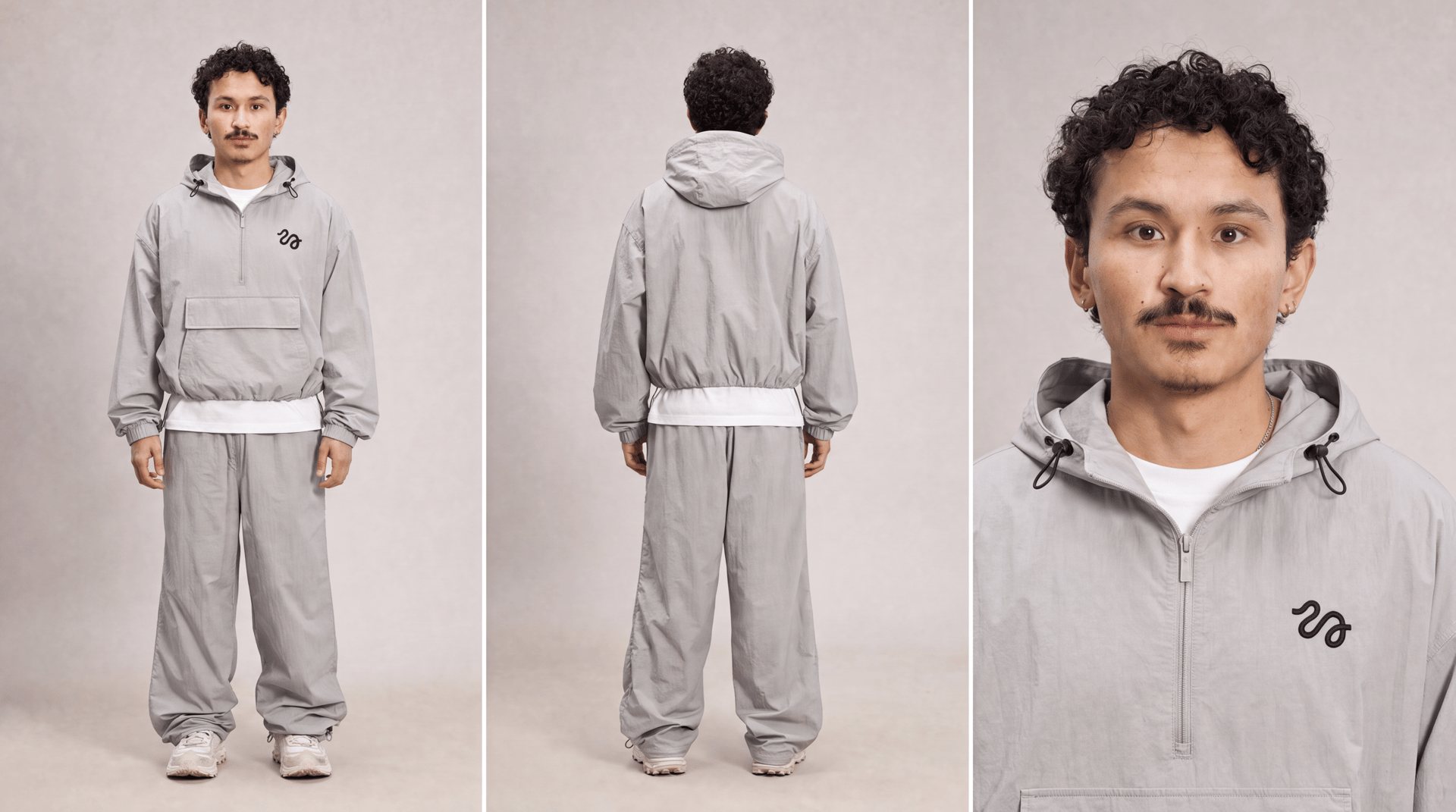
Professional film production character reference sheet from the provided reference images. Three equally-sized frames in a single horizontal row, neutral warm grey background, soft even studio lighting, no harsh shadows, natural foot shadow contact. FRAME 1 — front-facing full-body, head to toe, relaxed stance, arms slightly away from body. FRAME 2 — back-facing full-body, same framing, all rear clothing and hair details visible. FRAME 3 — close-up portrait from collar to crown, face filling the frame. Match the person from the first reference image exactly — same build, skin tone, curly hair, face, mustache, earrings and neck chain across all three frames. Wardrobe, consistent in all frames: a light-grey oversized hooded anorak pullover in crinkled lightweight nylon, shortened by its cinched hem — an elastic drawcord hem pulled tight at the natural waist so the boxy body blouses and balloons slightly over the gathered band; half-zip placket, drawstring hood with toggles, kangaroo flap pocket, dropped shoulders, elastic cuffs, matte crinkle-textured technical fabric with a subtle sheen; a plain white t-shirt layered underneath, peeking a few centimeters below the gathered hem. Matching light-grey wide-leg parachute track pants in the same crinkle nylon — voluminous baggy silhouette, elastic drawstring waist, long legs stacking and pooling slightly over the shoes. On the upper left chest of the anorak, a small printed logo in solid black — the exact logo from the second reference image: one continuous thick black rounded stroke drawn like a calligraphic scribble, a wave curve flowing into a tall arch and ending in a single closed loop at the lower right. Clean, sharp, undistorted, no other logos or text anywhere on the clothing. Off-white hiking sneakers with chunky lugged outsoles and light beige-grey technical accents, trail-runner silhouette. Shot on 35mm film. Fabric texture, stitching, hair, and skin all sharp and true to life, the way they look in real casting agency photography. No retouching, no smoothing, no artificial perfection — honest documentary production photography.

And the face-lock trick: crop the head out of the full-body frames, so the AI has exactly one place to pull the face from - the close-up

Remember the size-fit tip from Part 1? Let's make the AI's job easier and merge the images into one. I took a frame from the dragon's original sheet and my new character sheet, and combined them with Nano Banana 2.

Edit the image: add a tiny distant rider seated on the flying dragon. The first input image is the scene to edit, the second input image is the rider reference. CHANGE: place a TINY human figure seated astride the dragon's back at the base of the neck, in the gap between the neck spikes. EXTREME SCALE — the dragon is colossal, 15 times larger than the man: his seated figure is a small speck against the dragon's mass, no larger than one quarter of the dragon's head length, and the neck spikes beside him rise to his full seated height. He reads as a tiny silhouette of colour, no facial detail: dark curly hair, light-grey crinkle nylon hooded anorak with a sliver of white t-shirt at the hem, matching light-grey wide-leg parachute pants, off-white sneakers — the man and outfit from the second input image, head to toe. If scale is uncertain, render the rider SMALLER, never larger. Do not shrink, resize or move the dragon. Neutral riding pose: torso leaning slightly forward, legs astride the neck, hands gripping a neck spike. Clothing and hair pushed by flight wind. INTEGRATION — he belongs to the plate, not pasted on: rendered at the same exposure as the dragon, mostly a dark shape against the bright haze, a warm low-sun rim light tracing his head, shoulders and arms exactly like the rim on the dragon's back; his camera-facing side in soft shadow, cool grey haze filling it; his colors muted by the same atmospheric veil that softens the dragon; same focus softness and film grain as the plate, no extra sharpness; edges melting into the haze, no cutout halo; a soft contact shadow beneath him on the neck scales. PRESERVE EXACTLY: The dragon: pose, wingspan, silhouette, every scale and spike, the warm backlit translucent wing membranes The grey hazy background, light direction, atmospheric depth Framing, composition, camera angle Color grade, palette, contrast, grain ONLY CHANGE: the added tiny rider. 100% identical otherwise.

Locations

For locations use Soul Cinema - it gives the most cinematic frames. GPT skews yellow, Nano Banana makes locations too clean and symmetrical. It's also the cheap one: one GPT generation costs 7 credits - the same 7 credits in Soul Cinema get you 56 variations, so batch freely and test the winners in video. When you pick, watch the light: bad light is why video generations come out as slop.

Style: 8K IMAX. Photorealistic — no 3D render, no game engine. Lighting: Natural light only — contre-jour backlight, camera on shadow side, atmospheric haze throughout. Key light from sky and windows only. No artificial lightning. Color: 60:30:10 — dominant / secondary / accent. Camera: Physical cine lens. 180° shutter motion blur. Skin: Pore-level realism — vellus hair, asymmetric moles, capillary flush, pore-shadow matching on-set light. Acting: Hollywood — micro-pauses before reactions, precise eye-line, living eyes with catch-lights, chest rise from breathing. Characters never standing, always reacting. Physics: Gravity and inertia respected — mass has real weight, correct contact shadows. No floating props. Composition: Rule of thirds + golden ratio. Every person moving from frame one. Continuity: Characters, props, environment identical across every cut. No identity drift. Technical: 24fps smooth motion. 8K detail. No jitter. Audio: Environmental SFX only. No music. No subtitles. Characters: Location reference: @waterfall_location_v1 — the environment (the waterfall, the cave recess behind it, the gorge and canyon) 100% matches the reference across all shots. Active references attached: @adil_sheet_v2 (the rider) and @dragon_v1 (the dragon) — both stay entirely out of frame for this whole shot. No people, no animals, no creatures visible anywhere — a pure location reveal. Scene: High altitude inside a dense grey-white cloud layer hanging over a narrow Icelandic canyon. Below the clouds: a single tall waterfall dropping off the canyon rim past a dark cave mouth, layered basalt walls streaked ochre-yellow and green moss, a pale river threading the canyon floor, flat overcast light. The location must not be visible until the camera breaks through the cloud base. CUT 1 — Aerial ultra-wide 107° diagonal FOV, rectilinear, forward-diving drone move, lens locked for the whole shot: First frame: full whiteout inside the cloud — soft volumetric grey-white mist filling the frame edge to edge, faint brightness from above, thin vapor streaks rushing past the lens with the camera's speed. 0–4s: the camera pushes forward and slightly downward through the cloud mass, wisps whipping past, light pulsing brighter and dimmer as density changes. 4–6s: the cloud base tears open — ragged curtains of vapor part around the lens and the landscape resolves below in one continuous reveal. 6–12s: the full establishing vista: the canyon running away from camera, the waterfall at frame center dropping past the dark cave mouth, mossy ochre walls, the pale river far below; the camera keeps a slow cinematic glide forward and down toward the falls, trailing the last shreds of cloud past the frame edges. 12–15s: the glide settles into a calm approach, mist drifting off the waterfall, the vista holding wide and clean. Audio: muffled rushing wind inside the cloud, opening up into wide open-air wind and a distant waterfall roar the moment the camera breaks through. No music.

Scene 2

How to get real emotion with no video reference: describe the face in detail - what the character is going through, what he says, how his voice sounds, what his hands are doing. The swallow, the twitching fingers, the clenched jaw, the shaken-out hands, the exhale, the sprint. Seedance handles the light, and it comes out natural with zero compositing.

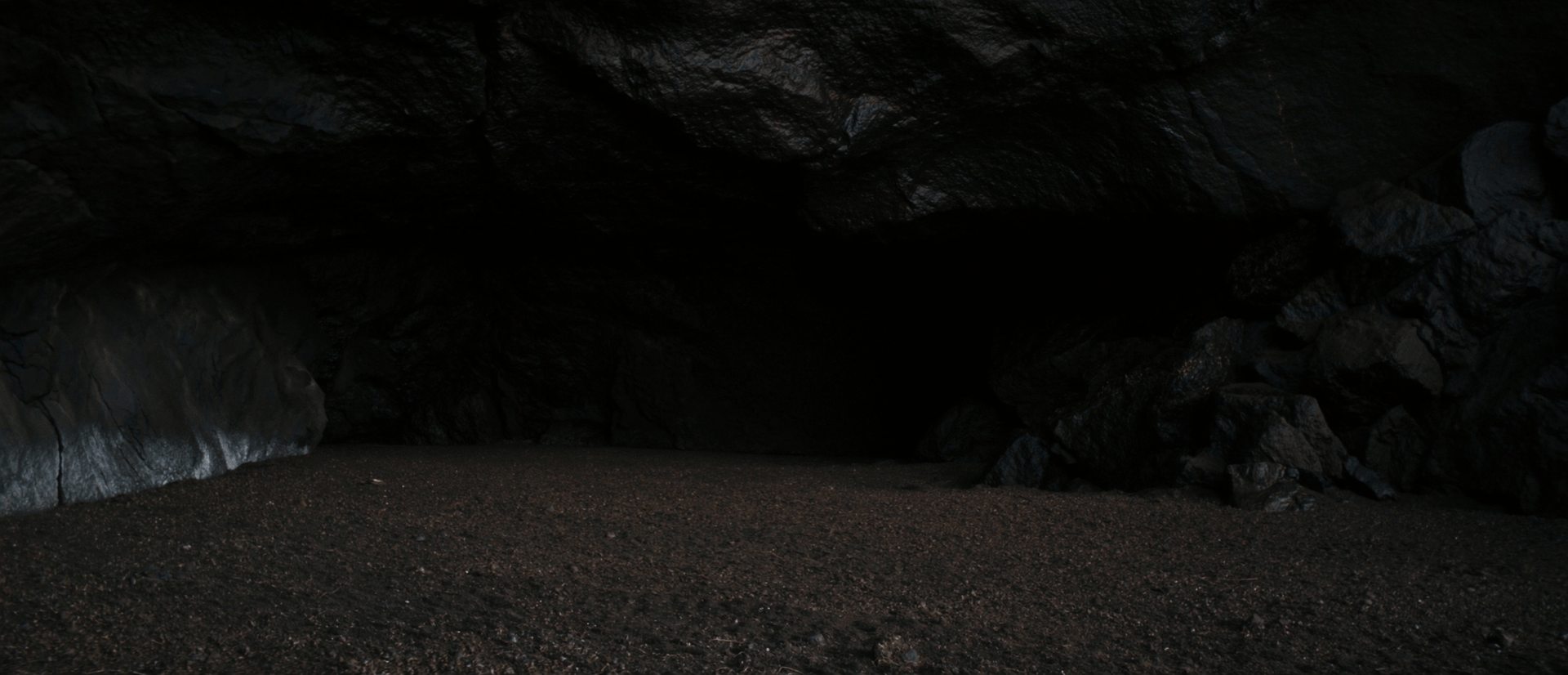
Reverse angle of the exact same basalt cave as in the reference image — same location, same materials, same color grade, now facing the opposite direction: the dead-end back of the cave. This side is completely sealed solid rock: no second opening, no tunnel, no daylight gap, no water, no waterfall anywhere in frame. The only light is a faint cold spill from the unseen cave mouth far behind the camera. MATCH TO REFERENCE — carry over exactly: — the same rough black basalt of the ceiling and walls: layered, horizontally streaked rock with wet sheen, identical texture scale and surface behavior as the overhang in the reference; — the same floor: dark grey-brown fine volcanic gravel with small pebbles, matte and slightly damp, identical grain size and tone as the foreground floor in the reference; — the same type of boulders as the cluster on the right side of the reference: large angular dark basalt blocks with sharp fractured facets and faint wet highlights on top edges; — the same cold overcast color palette: graphite black, wet slate grey, muted earth-brown in the gravel; fine film grain and soft naturalistic contrast identical to the reference frame. COMPOSITION: Foreground: the gravel floor fills the lower half of the frame, dimly lit by the light spilling from behind the camera, with faint glints on individual pebbles near the lens. Midground left: a continuous wet basalt wall with thin dark seep-water streaks, catching a low sheen at its base before sinking into shadow. Midground right: a cluster of large angular boulders matching the reference boulders — the brightest objects in frame, half-dissolved in darkness behind them. Background center: the solid back wall of the cave, rough basalt receding into near-total black. The central darkness reads as shadowed solid stone, not an opening — wall texture stays faintly traceable at the edges of the dark zone. No sky, no glow, no light coming from the depth. Ceiling: the same heavy basalt vault as in the reference, barely visible, closing the top of the frame. CAMERA: about 0.8 m above the gravel floor, level, aimed square into the dead-end depth, 84° wide rectilinear lens — floor, both rock masses and the black back wall in one frame. LIGHTING: single faint motivated source behind the camera (distant daylight from the cave mouth, diffused by waterfall mist); low-key exposure with rapid falloff; clean deep blacks without milkiness; dim grazing highlights only on foreground gravel, boulder facets and the wall base — exactly the same light temperature and softness as the daylight in the reference. No people, no animals, no man-made objects, no visible light source in frame.
SCENE CONTEXT ONE UNBROKEN CONTINUOUS SHOT — a single take with zero cuts, inside the cave recess @cave_test directly behind a BIG living waterfall — and the falls are present in every frame even though they are never seen: a deep constant roar filling the cave, fine spray drifting in on the air, mist hanging in the bounce light, wet gleam on the gravel. A frontal medium shot on @adil_sheet_v2 — and this shot lives on his face: a young man alone in the dark, genuinely scared, wrestling his own fear out loud before jumping THROUGH that waterfall. He faces the camera — and the cliff edge with the water curtain behind it — backs away two-three unsteady steps deeper into the cave to build his run-up while talking himself into the jump, voice cracking braver than his eyes; a false start he aborts, a shaky laugh at himself, one last deep inhale-exhale — and he explodes into a sprint straight at the lens while the camera pushes forward to meet him, blowing past the frame edge and gone toward the water. True real-time speed, fully grounded and alive. Exactly one person in this shot; no dragon, no other people, no creatures. ACTIVE REFERENCES @cave_test: the location — 100% matches the reference. The cave recess behind the waterfall: dark textured basalt walls with horizontal strata, wet gleams and moss streaks, a loose gravel-and-rock floor darkened with damp near the mouth side, the interior receding into deep shadow. The bright cave mouth and the falling water curtain sit BEHIND the camera — never visible in frame, but physically present: their roar, their drifting spray, their cool moving air, and their soft bounce light all live inside the shot. Geography, materials, colors, and atmosphere follow the reference; no new landmarks are invented. @adil_sheet_v2: Adil — HIGHEST IDENTITY PRIORITY, and there is EXACTLY ONE of him. His face is 100% locked to the reference in every frame: same bone structure, same dark brown eyes, same nose, same black mustache with a light chin patch, same short black curly hair and hairline, same small earrings in both ears, same warm skin tone, same beauty marks, same mid-20s age — the reference is the single source of truth, never regenerated, never averaged into a generic man, and EVERY emotional beat — the raw fear, the trembling breath, the nervous laugh, the set jaw of decision — is performed by this exact face. HIS EYES ARE ALIVE AND HUMAN: they blink naturally and irregularly throughout the take — quick nervous double-blinks, a hard blink after the down-glance, a slow half-second close on the reset — moist, catching light, never a frozen unblinking stare, never a dry mannequin gaze. Build: lean, average height. Wardrobe locked to the reference: a light-grey oversized nylon anorak hoodie with a half-zip, drawstring hood worn down, large front kangaroo flap pocket, and a small black curved wave logo embroidered on the left chest; a white t-shirt showing under the elastic hem; matching baggy light-grey nylon track pants with drawstring cuffs; chunky off-white trail sneakers; a thin silver chain at the neck — essentially dry, only a faint dusting of waterfall mist beading microscopically on the anorak shoulders and glinting in his curls, as anyone standing near big falls would carry. State: honestly frightened — heart hammering, hands unsteady — but forcing himself through it, the voice always half a step braver than the eyes. LOCATION MAP The camera stands inside the cave near the cliff edge, at Adil's chest height, aimed INTO the cave depth — its back to the unseen waterfall and daylight. Adil stands facing the camera a few meters in, on the gravel floor. Behind him: the cave runway — an open stretch of dark basalt floor receding into shadow, the far wall barely reading in the gloom. Between camera and Adil, and throughout the cave air: thin drifting waterfall mist, visible as a soft luminous haze in the bounce light, with occasional fine droplets floating through the frame and sparking tiny glints; the haze thins toward the cave depth. Soft bright bounce from the sky and water behind camera falls on his face and chest; the space behind him falls off into darkness. His movement axis is a straight line along the cave's length: first backward away from camera, deeper in — then forward at full sprint toward and past the camera, toward the edge and the falls behind it. The camera works on that same axis: easing backward as he retreats, then driving forward to meet his run. Camera stays on the axis the whole take; the waterfall is never shown. FIRST FRAME AND SPATIAL BLOCKING The first visible frame already contains Adil mid-emotion — no empty beat, no reveal, no neutral face: a frontal medium close-up, his face and shoulders filling the frame center, x 35% to 65%, and the fear already alive on him — eyes a little too wide aimed past the lens toward the edge, blinking fast, lips slightly parted around shallow breaths, one hand already rubbing its thumb across the fingertips; fine mist drifts through the light between him and the lens, a droplet glinting in his black curls; the pale grey anorak reads bright against the dark wet-gleaming cave wall behind him. Exactly one person in frame for the entire take. As he steps back the framing loosens from medium close-up toward a full medium shot — head to mid-thigh — always frontal, his face always toward camera, every flicker of it readable. FORMAT MODE ONE SINGLE UNBROKEN CONTINUOUS TAKE: zero cuts, zero transitions, zero frame jumps — one camera, one uninterrupted stream of real time at 1x natural speed. OPTICS 47° diagonal field of view, standard normal lens character — natural human-eye perspective, zero distortion, natural face proportions, comfortable depth of field: Adil razor-sharp down to the catchlights and the mist beads, the cave wall behind him soft but textured. Occasional drifting droplets near the lens read as brief soft specks, never smears, never on-lens water. One lens, locked, no zoom, no focal change. CAMERA One camera, genuinely HANDHELD — a documentary-alive operator feel: constant subtle micro-shake, breathing sway, small weight shifts and human corrections, the horizon never dead level for long — organic and nervous like the scene itself, but never whip-panning, never lurching, never nauseating. One continuous three-phase behavior on the cave's long axis. Phase one, retreat with him: as Adil steps backward, the handheld camera walks backward too, mirroring his pace a half-beat behind with real footstep sway, the frame widening from medium close-up to medium. Phase two, settle: when he stops for the final breath, the operator plants — the shake calms to breathing-level micro-movement, sitting with him in the fear. Phase three, drive: the instant he launches, the camera pushes FORWARD toward him with real accelerating handheld energy — shake intensifying with the run — holding his face and torso as he grows huge in two-three strides; he blows past the camera's left edge with strong directional blur, and the camera carries its jolting momentum one more beat into the emptied cave before easing to a stop. No pan-whips, no zoom, no angle change — one axis, in and out. ACTION TIMING One continuous chain at true real-time speed — every second carries a living reaction; lips move ONLY for the scripted lines: 0.0s to 2.5s: first frame on his frightened face — fast shallow breathing lifting his shoulders, a quick nervous double-blink, eyes flicking once toward the drop past the lens and jerking back like the look burned; he takes one slow unsteady step backward, then another, sneakers feeling the damp gravel, hands opening and closing at his sides; a nervous wet lick of the lips; mist drifts through the frame; the handheld camera walks back with him. 2.5s to 4.5s: he stops half-step, eyes pinned past the lens, blinks hard once, and speaks quietly, clipped, the first words catching: "Okay… you can do this." — a hard visible swallow, throat bobbing above the white tee collar, and a tiny involuntary head-shake right after the line. 4.5s to 7.0s: one more small step back — the third — his eyes flick DOWN toward the unseen drop and his breath audibly hitches, shoulders flinching; he drags his gaze back up, blinks hard twice, and pushes the next line out: "You just have to jump." — the last word wobbling slightly. 7.0s to 8.5s: a FALSE START — he rocks forward onto his toes as if to go, gets half a lean into it, and bails: rocks back hard, huffs a shaky breath through puffed cheeks, and lets a tiny nervous laugh escape — one breathy "hh", a crooked half-smile flashing and dying — his hand raking back through his mist-damp black curls. 8.5s to 10.0s: he plants himself, jaw working, blinking fast, and says it again — steadier, angrier at his own fear: "Just run — and jump. That's it." — a small sharp nod sealing it. 10.0s to 11.5s: the reset — one long controlled exhale through pursed lips, the breath visibly shaking at its tail and faintly fogging in the cool waterfall air; he shakes both hands loose at the wrists, the loose anorak sleeves flapping once, bounces on his toes, rolls his neck; his eyes close in one slow half-second blink — and open locked past the camera, face still and set: decision beating fear by one point. 11.5s to 13.5s: he EXPLODES forward — first stride driving off the gravel, a raw sharp exhale-grunt tearing out on the launch, second and third strides accelerating hard, body lowering, arms pumping, the baggy nylon snapping around his limbs, teeth bared with effort, growing huge in frame as the handheld camera charges to meet him — and he blows past the camera's left edge in a rush of directional blur, gravel kicking, mist swirling in his wake. 13.5s to 14.5s: the camera's jolting momentum carries one more beat into the now-empty cave — dark runway, mist drifting back into stillness, his last footfalls and one fading breath echoing under the roar — end of the single take. PHYSICS Everything obeys real-world body mechanics at real rates, and the fear is fully physiological: shallow uneven chest rise, a hard swallow with visible throat movement, micro-tremor in the fingers and in the exhale, weight shifting foot to foot, ELEVATED NATURAL BLINK RATE — irregular, human, roughly every one-to-two seconds under stress, with the scripted hard blinks and the slow reset blink layered on top — a faint sheen of cold sweat and condensed mist on his temple and upper lip, the nervous lip-lick, the involuntary head-shake — all readable, never cartoonish, never a frozen stare. Loose-clothing physics: the oversized nylon anorak and baggy track pants move with real fabric behavior — rustling and shifting with every step, the kangaroo pocket flap bouncing lightly, the hood drawstrings swinging, the elastic hem riding over the white tee; in the sprint the slipstream plasters the loose fabric back against his chest and thighs while the sleeves and pant legs snap and ripple. The waterfall's presence is physical: cool air moves gently through the cave, drifting the mist in slow visible currents; fine droplets float, settle, and glint; his exhale fogs faintly; the gravel near the mouth side is dark with damp and grips differently underfoot — his launch strides bite it with a wet crunch. The backward steps are careful: heel feeling for the gravel, weight transferring fully, small arm corrections. The false start is honest biomechanics: weight loads forward, torso tips — the abort throws it back through the heels, arms flaring. The nervous laugh jolts his shoulders once; the hair-rake flicks a fine spray of mist off his curls. The sprint launch is earned: back-foot load, torso past base, short explosive first stride, lengthening acceleration, arms opposite legs, gravel scattering, one stone skittering. The pass-by is a real near-miss with a felt whoosh. Dust and mist hang and resettle after him. No floating, no rubbery limbs, no teleporting; the cave stays completely static. LIGHTING Natural motivated light only: soft bright bounce from the unseen sky and waterfall behind the camera keys Adil's face and chest — even, wrapping, gentle — while the cave falls into deep shadow behind him. The pale grey anorak catches the bounce and separates him cleanly against the dark basalt, the small black wave logo reading crisply on his left chest, the white tee glowing softly at the hem and collar. The drifting waterfall mist makes the light VISIBLE: a soft luminous haze between camera and subject, faint volumetric depth in the bounce, tiny droplet glints crossing the frame; wet basalt and damp gravel carry low specular gleams. Both eyes hold clear moving catchlights that flicker naturally with every blink; the too-wide eyes, the swallow, the down-flick, the dying half-smile, the sweat-and-mist sheen, the final set jaw — all fully lit and readable, no shadow ever crushing his features. As he retreats deeper the key softens one step and the haze thins; the sprint carries him back into the brighter, mistier zone, light rising on his face over the final strides. No sun disc, no rays, no lens flare, no artificial light. Exposure protects his face; the cave shadow keeps faint texture, never flat dead black. AUDIO One continuous soundscape, no breaks, and the WATERFALL OWNS THE ROOM: a deep, powerful, ever-present roar from behind the camera — low rumbling bass with a hissing spray top layer, swelling and easing in slow natural waves, echoing off the cave walls — loud enough that Adil speaks slightly over it; occasional fat droplets smack the gravel; the cool air moves audibly. Inside that: Adil's uneven breathing close and intimate, hitching at the down-glance; the soft nylon rustle of the anorak with every movement; damp gravel crunching under each backward step; his three quiet lines — "Okay… you can do this." … "You just have to jump." … "Just run — and jump. That's it." — spoken by Adil only, in English, exactly these words and nothing more, pushed slightly against the roar, the first delivery tight and thin, the last one firmer; between the second and third lines the huffed shaky breath and one tiny breathy laugh — non-word; the long trembling exhale of the reset; the soft slap of shaken hands; the raw sharp effort-grunt on the launch — non-word, Adil only; then explosive pounding footfalls rushing toward and past the lens with a whoosh, swallowed by the rising roar as he heads for the water. No other voices, no ad-libs, no music, no subtitles. STYLE Grounded photoreal cinema — intimate, tense, human; a fear-and-courage character beat against the physical presence of a giant waterfall. No 3D-render look, no game-engine smoothness, no slow motion. Natural 180-degree shutter motion blur at real-time speed: the dialogue and reaction beats hold razor-sharp through the handheld sway, the false start reads clean, the sprint and pass-by carry strong honest directional blur. Pore-level skin realism in the soft misty light — vellus hair, the adrenaline flush rising through the take, the cold-sweat-and-spray sheen, living blinking eyes with dancing catchlights. Real organic film grain, deep filmic contrast with lifted shadow detail. Muted grade: dominant dark basalt grays and umber, secondary soft daylight and mist on skin, the pale grey anorak and white tee as the light accents. POSITIVE LOCKS One single unbroken take: zero cuts, zero transitions, zero frame jumps, one handheld camera from first frame to last. Exactly one person in the entire shot — a single Adil, never duplicated; no dragon, no silhouettes, no figures in the shadows. Adil's identity locks to @adil_sheet_v2 with absolute priority in every frame — same face, dark brown eyes, black mustache with light chin patch, black curly hair, earrings, skin tone — and the same outfit: light-grey half-zip anorak hoodie with the black wave logo on the left chest, white tee underneath, baggy grey nylon track pants, off-white trail sneakers, thin silver chain — zero drift, zero substitution, no wardrobe changes, through every expression change; his face stays toward camera until the sprint carries him past it; the hood stays down the whole take. HIS EYES BLINK NATURALLY AND IRREGULARLY THE ENTIRE TAKE — nervous quick blinks, hard blinks, one slow reset blink — never more than two seconds without a blink, never a frozen stare. The waterfall's presence persists the whole take: constant roar, drifting visible mist, damp gravel, cool moving air — but the falls themselves are NEVER visible; they exist only as light, spray, and sound behind the camera. His clothes stay essentially dry with only faint mist beading — never soaked. The emotional arc locks in this exact order, each beat once: frightened breathing and fidgeting → line one with swallow and head-shake → third step back, down-glance with breath hitch → line two with a wobble → ONE false start aborted → ONE nervous breathy laugh with hair-rake → line three, firmer, with a nod → trembling fogged exhale reset with slow blink → explosive sprint with ONE effort-grunt → exit past the lens. Dialogue is ONLY the three scripted English lines in that order — no extra words, no ad-libs, no off-screen voices; the laugh and grunt are wordless. His fear is human-scale — trembling, hesitating, self-mocking — never sobbing, never screaming, never frozen panic. The camera moves only on the cave's long axis with organic handheld life: back with his retreat, planted for the breath, forward to meet his run — no pan-whips, no angle change, no zoom. Adil fully exits past the camera's left edge before the end, leaving at least one beat of empty misty cave. The whole shot plays at 1x real-time speed — no slow motion anywhere. 47° lens locked. Sharp clarity through natural handheld motion, stable exposure, no flickering, no ghosting.

Scene 3

This time the whole beat runs in one continuous shot - and here's the voice tip: Seedance locks the voice along with the appearance in the character sheet, so the scream stays consistent across generations without describing it every time. The camera chases the run, stops dead at the cliff lip, and the one-second empty frame builds the tension before the dragon erupts.

Style: 8K IMAX. Photorealistic — no 3D render, no game engine. Lighting: Natural light only — contre-jour backlight, camera on shadow side, atmospheric haze throughout. Key light from sky and windows only. No artificial lightning. Color: 60:30:10 — dominant / secondary / accent. Camera: Physical cine lens. 180° shutter motion blur. Skin: Pore-level realism — vellus hair, asymmetric moles, capillary flush, pore-shadow matching on-set light. Acting: Hollywood — micro-pauses before reactions, precise eye-line, living eyes with catch-lights, chest rise from breathing. Characters never standing, always reacting. Physics: Gravity and inertia respected — mass has real weight, correct contact shadows. No floating props. Composition: Rule of thirds + golden ratio. Every person moving from frame one. Continuity: Characters, props, environment identical throughout. No identity drift. Technical: 24fps smooth motion. 8K detail. No jitter. Audio: Environmental SFX only. No music. No subtitles. Characters: Location reference: @loc_inside2 — the environment (cave recess, cliff lip, the waterfall in front of it, the gorge) 100% matches the reference. @adil_sheet_v2 — the rider, 100% matches the reference (face, hair, build, wardrobe). Dry until the waterfall pass. @dragon_v1 — the dragon, 100% matches the reference (anatomy, hide texture, wing membranes, spike rows). No saddle, no harness: the rider lies pressed flat on the spine ridge between the wing roots, bare hands locked around the back spikes, legs clamped against the spine. Scene: ONE SINGLE CONTINUOUS UNBROKEN SHOT — one take, one camera, one uninterrupted recording, strictly real-time 1x speed: no editing, no slow motion, no freeze frames. Inside the cave recess behind the waterfall, facing out. Between the cliff lip and the falling water there is a wide corridor of open air — the waterfall hangs well away from the cave. The torrent itself is an immense, extremely dense mass of white falling water, flood-volume, so thick that nothing can be seen through it, throwing heavy spray. @adil_sheet_v2 is in the final stride of his sprint toward the edge; the camera chases behind him. Camera — one continuous handheld chase from behind, 84° diagonal FOV, shoulder height, 2 m behind the runner. Hard endpoint: THE MOMENT HE LEAPS INTO THE VOID, THE CAMERA STOPS DEAD AT THE CLIFF LIP — no tilt down after him, no drift, no push in; from that instant it is a static locked frame to the last second. Lens locked: First frame: his back mid-frame, full sprint, one step from the lip, gravel spraying off his heels, the torrent dead ahead. 0–1s: one last accelerating stride, camera shaking with the run. 1–2s: at the lip he dives off the cliff exactly like a diver entering water — arms swinging forward past his head, palms together, body stretching into one line and tipping over headfirst — screaming "AAAAAH!" as he goes over, dropping out of the bottom of the frame, the scream fading down; at this exact moment the camera stops dead at the lip and locks: the empty air corridor ahead, the water mass beyond it, drifting spray. 2–3s: ONE SECOND of stillness on that locked frame — no figure anywhere, only the falling water, drifting mist, the roar. Tension hangs in the emptiness. 3–5s: the dragon EXPLODES up into the frame from below the cliff edge — rising inside the air corridor, clearly in front of the torrent, closer to the lip than to the water: one violent vertical burst, sudden like a breaching whale, back and tail to camera, heavy directional motion blur, two brutal wing strokes, grit blasting over the lip — the rider pressed flat between the wing roots, jolting with the burst. 5–6s: at the top of the burst, in the same motion, it snaps over — head pitches forward, tail whips up — vertical momentum converting straight into forward drive, no hover. 6–15s: it charges FORWARD away from the camera and punches horizontally through the torrent: true fluid physics — tons of water shatter at the impact point, the dragon vanishing inside the mass for a split second, then bursting out the far side hauling sheets, ropes and spray on real ballistic arcs; water cascades off the wings; the torrent slams shut behind it as if never broken; fine droplets spatter the lens. It flies on into the bright haze, shrinking, the camera holding its locked frame to the end. Audio: footsteps and hard breathing, the raw scream fading into the roar, one second of waterfall thunder alone, then an eruption of wing-thunder from the gorge, the concussive detonation of the breached torrent, hissing away with distance. No music. One unbroken take: camera moves only during the chase, stops dead at the leap, stays static to the last frame. He and the dragon are out of view only during the one-second stillness. Exactly one man and one dragon in the whole shot.

Scene 4

SCENE CONTEXT ONE UNBROKEN CONTINUOUS SHOT — a single take with zero cuts, starting AT the waterfall in the moment of the burst: the shot opens on the thin waterfall veil of @waterfall_location_v1 seen strictly from the side, edge-on at screen-left — and within the first second @dragon_v1 with its single rider @adil_sheet_v2 explodes out through the water sheet and everything continues from there in one flow: the dragon gives one quick dog-like head-shake, its trailing fan of spray sweeps back and drenches Adil's face and hair in a natural shower of scattered droplets, he sputters a startled "oh-oh-oh!", clamps down in real fear of falling, steals a glance at the drop, risks a one-hand face-wipe and presses himself flatter — then a smile blooms and breaks into a raw, joyful adrenaline yell, he gives the dragon's neck two light grateful pats, and rides a tight exhilarated grin as the dragon accelerates, outruns the camera and exits frame-right. After the veil slides out of frame-left, NO waterfall ever appears again — not ahead, not in the background, not anywhere. Scale locked to @size_ref_v2. True real-time speed — no slow motion. Exactly one dragon and one rider; no other people, animals, or creatures anywhere. ACTIVE REFERENCES @waterfall_location_v1: the location — 100% matches the reference for geography, rock strata, materials, colors, and atmosphere: the basalt cliff, the light slender waterfall veil, the dark cave gap behind it, the gorge with its modest pool and outflow stream, canyon walls streaked ochre and green moss, hazy far ridges, flat overcast sky. The flow is a light veil, not a heavy column. In this shot the veil stands edge-on at screen-left only for the opening breach, then leaves frame forever. No new landmarks are invented; no second waterfall exists anywhere in this canyon. @dragon_v1: the dragon — 100% matches the reference (anatomy, hide texture, wing membranes, spike rows, proportions). House-sized, charcoal-black, bat-like wings with translucent amber-brown membranes, rows of black spikes down the spine, long tapering spiked tail, four clawed limbs, hide like wet volcanic rock, streaming water; no saddle, no harness. It carries exactly one rider and no one else. Identity stays stable for the entire shot. @size_ref_v2: the SIZE AND POSE REFERENCE — the scale law of this shot. Rider-to-dragon proportion locked exactly to this reference: the rider a small figure roughly one-tenth of the body length, seated at the neck base in front of the wings, legs astride the neck, dwarfed by the wingspan. The proportion never drifts in any frame. @adil_sheet_v2: Adil, the rider — HIGHEST IDENTITY PRIORITY, and there is EXACTLY ONE of him: a single Adil at the neck base, never two riders, never a duplicate anywhere in frame. His face is 100% locked to the reference in every visible frame: same bone structure, same eyes, same nose, same thin mustache, same hairline and hair color, same skin tone, same mid-20s age — the reference is the single source of truth, never regenerated, never averaged into a generic man, never altered by water, blur, distance, or ANY expression: the shock, the fear, the grimace, the yell, and the grin are all performed by this exact face — expressions change, identity never does. Wardrobe locked: oversized light-grey hooded nylon anorak with a small black chest emblem over a white t-shirt, baggy light-grey nylon pants, off-white chunky sneakers, all soaked, hair plastered down keeping his exact hairline. He rides low against the neck base, arms wrapped around a neck spine. Zero identity drift from first visible frame to last. LOCATION MAP The camera sits OFFSET TO THE SIDE of the falls, not in front of them: its optical axis runs parallel to the cliff face, so the waterfall reads edge-on as a narrow translucent ribbon at screen-left — the front face of the falls is never visible and the falls are never frame-centered. Behind the veil, the dark cave gap from which the dragon erupts. The basalt cliff runs along frame-left and falls behind as the flight proceeds; the modest plunge pool and pale outflow stream sit at the veil's base, lower-left, visible only in the opening seconds. The right three-quarters of frame is open canyon air: layered hazy ridges, ochre and umber slopes, drifting thin mist, flat overcast sky. The flight line runs out of the cave perpendicular to the veil, then bends level and parallel to the cliff, screen-left to screen-right; the camera travels on a rail-straight lateral path on the canyon side of that line, holding the dragon in full side profile at constant height — the same side-on angle from first frame to last, never crossing the line, never rotating toward the falls. FIRST FRAME AND SPATIAL BLOCKING The first visible frame shows the veil edge-on at x 8% to 13%, falling from y 18% to y 80%, the dark cave gap behind it, mist and the small pool at its base lower-left — and the water is ALREADY reacting: the sheet visibly bulges outward around a dark mass pressing through from behind. This is a half-second live fuse, not a static establishing beat — the burst detonates within the first second. Once through, the frame holds exactly one dragon carrying exactly one rider at @size_ref_v2 scale: body spanning roughly x 25% to 65%, wingspan about 60% of frame width, Adil a small soaked figure about 4% of frame height at the neck base, seated on the camera side of the neck, head in three-quarter view toward camera — every expression readable for the entire take, never hidden behind the neck. The dragon's back behind him and the tail are completely empty. FORMAT MODE ONE SINGLE UNBROKEN CONTINUOUS TAKE: zero cuts, zero transitions, zero fades, zero frame jumps — one camera, one uninterrupted stream of real time at 1x natural speed. OPTICS 84° diagonal field of view, classic wide-angle lens character. The full side-on wingspan fits in frame with air around it, straight basalt strata stay rectilinear, deep focus from the near wing to the far ridge, no fisheye curve — Adil's face and every micro-expression hold sharp at the flight distance. Stray droplets near the lens read as brief soft specks, never smears. One lens, locked, no zoom, no focal change. CAMERA One aerial camera, hovering side-on at mid-veil height as the shot opens, framing the bulging water sheet at screen-left. At the burst it picks up the dragon and eases into a lateral tracking move — lagging half a beat with heavy-platform inertia, then matching the dragon's speed on a rail-straight path parallel to the flight line, holding it centered in full side profile at constant distance and constant height — the exact same side-on angle for the entire take. The waterfall edge slides out of frame-left within the first two seconds and the frame never turns back toward it. In the final phase the dragon accelerates beyond the camera's pace: the camera eases its ramp and settles, the dragon pulls ahead, shrinks slightly with true distance, and exits frame-right. Tilt and roll stay fixed; every speed change is smooth and weighted. No pan-whips, no zoom, no push-in, no reframing jolts, no crossing the action line. ACTION TIMING One continuous chain of cause and effect at true real-time speed — Adil's face carries a readable emotional beat in every phase: 0.0s to 0.8s: the veil bulges — the dark mass pushes the sheet visibly outward, water tenting around the shape of a skull. 0.8s to 2.2s: THE BURST — the veil parts around the skull with almost no resistance, ribbons whipping aside and collapsing into spray, water sheeting off brow and shoulders, wings tearing free and snapping open, the last streamers shredding into fine droplets as the whole body clears the water and levels into flight, moving screen-left to screen-right; Adil rides it adrenaline-wide — eyes shining, mouth half-open gulping wind, knuckles white on the spine, a tense thrilled almost-smile flickering. 2.2s to 3.4s: ONE quick head-shake — a fast dog-like rotary shake of skull and upper neck, two or three oscillations in under a second, water leaving tangentially in helical arcs that break into fans of separate droplets — and the trailing fan sweeps back along the slipstream and rakes over Adil as a natural drenching shower: scattered droplets pepper his face and hair, fresh water streaming down his cheeks and off his chin, his wet curls flattening harder against his forehead; he flinches and blinks into it, head ducking a fraction — a soaking, not an impact. 3.4s to 5.2s: shock beat — showered and dripping, he sputters, spits a mouthful of water sideways, jerks droplets off his own head, blurts a breathless startled "oh-oh-oh!", ducks and clamps his whole body flat against the neck, both arms cinching around the spine, face scrunched, eyes squeezed shut. 5.2s to 7.5s: fear beat — still pressed low he cracks one eye open, steals a wide-eyed glance DOWN at the canyon drop, visibly swallows hard, jaw tightening — genuinely afraid of falling; then the risky wipe: knees and one arm clamp harder as he peels the other hand off the spine, drags the heel of his palm down across his face in one firm wipe with a squinting grimace, clearing his eyes and slicking wet curls off his forehead, and immediately slaps the hand back onto the spine — pressing himself flatter than before, chest to hide, cheek almost touching it. 7.5s to 9.5s: joy breaks through — vision clear, still gripping, he puffs out a huge cheek-swelling exhale, and a smile spreads across the dripping face, wider and wider, until he throws his head into the wind and lets out a raw, joyful adrenaline yell — half laugh, half scream, a full unhurried breath of it, veins standing in his neck, water flying off his hair — pure pleasure, zero fear left in it. 9.5s to 11.0s: gratitude beat — steady level flight, the yell settling into ragged happy breaths; Adil clamps down with knees and one arm, lifts the other hand and gives the dragon's neck hide two light, affectionate open-palm pats — a small "thank you", each contact clearly readable — then plants the hand straight back onto the spine. 11.0s to 13.5s: exhilaration and acceleration — the dragon stretches its head low and surges, wingbeats quickening from one every two seconds toward one per second; Adil's grin narrows into a tight, wind-slitted exhilarated grin, eyes bright against the airflow, body glued low but riding the surge now instead of hiding from it; background parallax speeds up continuously; the frame is pure open canyon — no waterfall anywhere; the camera eases off its ramp and holds. 13.5s to 15.0s: the dragon pulls ahead and exits frame-right completely, tail last, Adil's grin the last readable human detail; the locked side-on frame holds a full final beat on empty canyon air — drifting mist, hazy ridges, no waterfall — end of the single take. PHYSICS Everything obeys real-world physics at real-world rates, at true house-sized @size_ref_v2 scale — heavy wingbeats, huge inertia, nothing flutters. The burst: the dragon's mass drives a pressure bow-wave that tents the sheet before contact; a light curtain parts around mass rather than exploding — ribbons whip aside, cling briefly to the wet hide, slide off in sheets along the body's curves, then drop away; heavy drops fly farthest in clean parabolas, fine mist stalls and hangs; the parted veil re-threads only from the lip downward as new water arrives, sliding out of frame as it does. The head-shake obeys rotation physics: the skull oscillates fast around the neck axis, loose skin lagging behind bone, water leaving tangentially in helical sheets that immediately break into chains and fans of separate droplets — no ropes, no jets, no single connected mass; the aft-swept fan is carried by the slipstream and rakes across the rider as distinct drops of many sizes, each on its own ballistic arc, peppering his face and hair, running off his chin, secondary droplets ripped away by the wind; the neck damps the shake in two beats and the flight line never wavers. Adil's reactions are body-mechanical and cost real effort: the sputter sprays fine droplets ripped away by the slipstream; his head-jerk flings water from his hair in a small fan; the flinch is whole-body — shoulders jump, grip cinches with visible arm strain; the downward glance freezes him for a beat, throat moving in the swallow; the one-handed wipe is a genuine risk, so knees and the remaining arm clamp visibly harder while the free hand works, the palm dragging the water off in a smeared sheet torn away instantly by the wind; the hand plants back and the torso flattens further; the yell shakes his chest, breath tearing away visibly in the airstream; the neck pats are the same disciplined mechanics — clamp first, brief one-hand release, two soft palm contacts that knock a thin film of water off the wet hide in small splashes, hand straight back to the spine. The acceleration is earned stroke by stroke: wing spars bend visibly under each downstroke, membranes belly and snap flat with tension wrinkles then slacken a fraction on the upstroke, cadence rises, glide gaps shorten, the neck stretches into a drag-tight line, the spiked tail streams straight with whip-lag — background parallax grows continuously, plus true perspective shrink as the dragon pulls away from the settled camera. Water on the hide sheds heaviest in the burst and the shake, thinning to a fine trailing spray; wet hide gleams, drying patches go matte. Adil's soaked anorak stays pinned flat by the slipstream, its loose hem snapping faster as speed climbs; nothing distorts, covers, or reshapes his facial features — every expression lives on the exact reference face. Mist drifts on one consistent wind. No floating, no rubbery motion, no teleporting; cliffs and canyon stay completely static. LIGHTING Flat overcast daylight — the cloud dome as one giant soft source from above; no sun disc, no rays, no cast shadows, no lens flare, light constant for the whole shot. Soft even sky light keeps every beat of Adil's face fully readable: the adrenaline-wide eyes with bright catchlights at the burst, the droplet shower glistening on his cheeks and curls at the shake, the scrunched shut-eyed flinch, the one-eyed downward glance, the grimace of the wipe, the blooming smile, the open-mouthed joyful yell, the two gentle pats, and the final narrowed grin — the thin mustache resolved throughout, no shadow ever crushing his features. The burst ribbons and the head-shake droplet fans flash bright against the dark cliff; the veil reads semi-translucent against the cave gap while in frame. The wet charcoal hide reads by broad soft speculars; the amber-brown membranes glow faintly translucent on each upstroke — the single warm color accent of the frame. Aerial haze steps the far ridges brighter and cooler with distance. Exposure protects the white water, the spray, and Adil's face — highlights keep texture, never clip, gentle halation on the burst. AUDIO One continuous soundscape, no breaks: the waterfall's hiss and a swelling pressure surge in the first half-second; the wet tearing splash of the burst at 0.8s; wings snapping open; the hiss fading out left by 2.2s; at 2.3s the rapid wet flutter-slap of the head-shake and the raking hiss of the droplet fan sweeping over the rider; at 3.5s Adil's sputter and spit, then his quick startled "oh-oh-oh!"; a tight audible swallow as he glances down; the squeak-drag of a wet palm across skin at 6.5s; at 8s one big whooshing exhale rolling straight into a raw, joyful adrenaline yell — half laugh, half scream, torn by the wind, riding a full breath; at 10s two soft wet pats of a palm on hide in the steady wingbeat rhythm — Adil's only vocalizations: the sputter, the "oh-oh-oh!", and the joyful yell, no words, no other voices; then wingbeats coming quicker and quicker, wind noise climbing, the whole mass of sound doppler-fading right as the dragon pulls away; open canyon wind alone on the empty end frame. No music, no subtitles. STYLE Epic photoreal cinema — grounded physical realism, no 3D-render look, no game-engine smoothness, no slow-motion aesthetics. Natural 180-degree shutter motion blur at real-time speed: the burst, the head-shake, and the downstrokes carry strong directional blur on water and wings, resolving into sharp readable beats for every one of Adil's expressions — the shower, the sputter, the glance, the wipe, the smile, the yell, the pats, the grin — blur never smears his features into a different face. Real organic film grain, deep filmic contrast curve with lifted shadow detail. Muted desaturated grade — dominant ochre and umber terrain, secondary cool gray sky and haze, white water accent — with Adil's emotional arc as the heart of the frame. POSITIVE LOCKS One single unbroken take: zero cuts, zero transitions, zero frame jumps, one camera from first frame to last. The shot starts AT the waterfall and ON the burst: the veil is already bulging in frame one and the dragon breaks through within the first second — no long empty establishing beat, no cave interior, no approach shot. The waterfall appears ONLY edge-on at screen-left during the burst, is never frame-centered, exits frame-left by 2.2s, and NO waterfall ever appears again anywhere in the frame — no second falls, no water curtain in the background, none. The camera holds one strict side-on lateral angle the entire time — optical axis parallel to the cliff, full profile on the dragon, constant height — no push-in, no pan-whip, no angle change, no crossing the line. Adil's emotional arc locks in this exact order and only once each: adrenaline-wide eyes at the burst → ONE head-shake (2.2s–3.4s) → ONE natural drenching droplet shower over his face and hair — the spray reaches him only as scattered separate droplets on ballistic arcs, always a shower, never a rope, jet or slap → sputter and spit → startled "oh-oh-oh!" and full-body clamp → ONE scared glance down with a swallow → ONE face-wipe with the heel of his hand while gripping harder → press flatter → big exhale blooming into a smile → ONE raw joyful adrenaline yell → TWO light one-hand pats on the neck with the other arm and knees clamped, hand straight back to the spine → tight exhilarated grin to the exit. His vocalizations are only the sputter, the "oh-oh-oh!", and the joyful yell — no words ever; his fear is small and human — afraid of falling, gripping harder — and the only scream in the shot is the yell of joy. After the pats the dragon only accelerates — speed never drops — and it fully exits frame-right before the end, leaving at least one full beat of empty frame. Adil's face locks to @adil_sheet_v2 with absolute priority in every visible frame — same eyes, nose, thin mustache, hairline, skin tone — zero drift, zero substitution, through every expression change; his face stays in three-quarter view toward camera whenever visible. Exactly one rider total — a single Adil, never duplicated; the dragon's back and tail stay empty. Exactly one dragon, 100% matching @dragon_v1, zero identity drift. Scale locked to @size_ref_v2 — the rider one-tenth of the body length, never drifting. The whole shot plays at 1x real-time speed — no slow motion anywhere. Screen direction locks left to right. No other creatures, people, vehicles, or buildings ever appear. Overcast holds; no sun ever appears. 84° lens locked. Sharp clarity, stable picture, no flickering, no ghosting.

Scene 5

For high-speed shots, put the camera language right in the request: a 180-degree camera orbit, speed shake, and lens droplets for realism. Dynamic without turning the subject into blurry slop.

SCENE CONTEXT A colossal dragon with its rider races low through a winding rocky gorge, weaving around jutting rock buttresses and punching through a low-hanging cloud shred while a hard-shaken chase camera follows behind its tail, its lens catching spray; bursting into an open reach, the camera arcs 180° around the flying dragon and ends dead ahead, facing it head-on. One continuous chase-to-reveal shot, real time. ACTIVE REFERENCES @dragon_v1 — the dragon: charcoal-black hide like wet volcanic rock, translucent amber-brown wing membranes, black dorsal spike rows, long spiked tail, wingspan of fourteen men laid head to toe, heavy as five elephants. No saddle, no harness. 100% matches the reference; ignore the sheet's grey background. @adil_sheet_v2 — the rider: mid-20s man, short dark curly hair, damp and wind-whipped, thin black mustache, damp light-grey hooded anorak with a small black curled chest emblem, bare hands. 100% matches the reference; ignore the sheet layout and studio background. @size_ref_v2 — proportion and mount only: the rider sits astride the neck base between the wing roots at exactly this rider-to-dragon scale, held in every frame; his face and wardrobe come from @adil_sheet_v2, the man in this reference is a scale stand-in. Ignore its background and lighting. LOCATION MAP A wild, winding Icelandic gorge under a heavy broken cloud deck. Foreground: braided shallows of a pale glacial river threading between moss-capped boulders the size of houses. Midground: the gorge bends left then right, fractured basalt buttresses and rock spurs jutting alternately from either wall into the flight path, scree fans at their feet, gaps between spur and wall narrower than the dragon's wingspan; one ragged shred of low cloud hangs inside the gorge below the rim, snagged across the flight line. Background: broken stepped walls streaked ochre and green moss rising to a ragged skyline, dense grey-white cumulus stacked above with narrow torn gaps, one thin sun blade sweeping the far wall, cloud shadows crawling over the rock. FIRST FRAME / BLOCKING Chase framing from directly behind: the dragon fills the mid-frame flying away from camera at 130 km/h, three meters above the braided river, wings at full span, @adil_sheet_v2 leaning low on its neck base between the wing roots, both hands locked on a dorsal spike; the first bend of the gorge and its jutting buttress stand ahead, half in soft cloud light, the low cloud shred visible beyond; the frame already carries a fine speed vibration and two small water beads at its lower edge. FORMAT MODE One continuous shot, real time throughout; the camera does not cut on its own. OPTICS 84° diagonal FOV, rectilinear, one wide prime character for the whole shot, natural 180° shutter motion blur, focal length locked; a physical front element riding open in the airstream — water beads and streaks live on the lens glass and refract the scene like a hard-mounted action camera. CAMERA Chase drone 15 meters behind and slightly right of the tail at matched 130 km/h, three meters altitude: through the gorge it banks with every turn a half-beat late, threads the same gaps, and punches through the same cloud shred two beats after the dragon. At 10 seconds, over the open reach, it accelerates hard, swings wide out to the dragon's right flank and carves a level 180° arc around it — past the full side profile at 12 seconds — settling dead ahead of the dragon at 13 seconds, flying backward at matched speed, aimed straight down its incoming flight line, holding constant distance for the final beats. The whole chase rides a constant fine speed vibration — a one-to-two-centimeter high-frequency tremor — with discrete jolts on top: a kick in every wingbeat wash, a hard buffet through the cloud shred, and continuous heavy buffeting inside the dragon's bow-wave through the backward-flying head-on finale. The arc's path itself stays smooth and machine-driven; the shake lives on top of it as fine vibration, never swinging the framing off the subject. Focus rides the dragon and rider throughout. ACTION 0–4s: full-speed run up the braided river — each heavy downstroke slams a pressure ring onto the water and rips twin spray vortices off the wingtips, a V-shaped wake tearing between the boulders; the first fine spray beads tick onto the lens glass and streak toward the frame edges in the airstream; the dragon lifts a wing to clear a house-sized moss-capped monolith by arm-lengths; the rider flattened low, anorak cracking. 4–7s: the first bend — the dragon rolls into a knife-edge left bank around a jutting buttress, wings near-vertical so the span fits between spur and wall, the low wingtip slicing a curtain of spray that rakes across the lens — a burst of distinct droplets lands and stays, beads trembling with the vibration, crawling outward; mid-move the buttress whips between camera and dragon, wiping the frame for two beats. 7–10s: out of the bank straight into the hanging cloud shred — the dragon punches through it, vapor exploding off its leading edges and streaming from the wingtips in torn ribbons; the camera punches through two beats later with a hard buffet — a wet film fogs the glass for a breath and tears away in the airstream, leaving fresh beads scattered across the frame — and they burst out the far side together into an opening, wider reach of the gorge. 10–13s: the dragon holds straight, level, powerful flight up the middle of the open reach, vapor still shedding off its spikes, while the camera arcs around it; as the thin sun blade through a cloud gap crosses the flight line the wing membranes flash translucent amber against the dark walls, and every bead on the lens glass flares into a tiny prismatic spark. 13–15s: head-on at last — the dragon barrels straight at the lens in full frontal power, head low, wingbeats hammering toward camera, wing-thrown spray spattering one last fresh burst across the glass, beads shivering in the bow-wave buffet; @adil_sheet_v2 stays low over the neck, both hands still welded to the spike, and plays the whole beat with his face alone — the grin cracking wide into a shredded yell of pure joy, brows high, eyes blazing straight past the lens between the trembling droplets. Displaced air shoves mist outward on every pass. PERFORMANCE Both of the rider's hands grip the neck spike in every single frame — they never open, never lift, never wave. Everything lives in the body lean and the face: pressed flat through the banks, head tucked behind the spike in the cloud punch, then in the head-on finale the face carries it all — grin breaking into a yell, cheeks shuddering in the airstream, damp hair whipping, catch-lights flaring as the sun blade passes. PHYSICS Thirty tons at 130 km/h: carved banks with visible wing flex, spray and wake obeying the wingbeat rhythm, vapor tearing honestly around the body in the cloud punch, real inertia in every turn; through the camera's arc the dragon's own flight stays straight and level — all curving motion belongs to the camera. Droplets on the glass obey the airstream — landing as distinct beads, trembling with the vibration, streaking toward the frame edges; the wet film from the cloud punch tears off in under a second. The rider's 80 kg leans a fraction ahead of every roll. Gaps narrower than the wingspan are passed only in knife-edge bank or half-fold, wingtips clearing rock by arm-lengths. LIGHTING Heavy broken-cloud daylight: dominant soft luminous 6000K cloud light with crawling shadow patches, one hard 5600K sun blade sweeping through a torn gap — crossing the flight line exactly at the camera arc's side point, flaring the membranes amber contre-jour and sparking the lens beads; wet hide and churned water picking soft speculars, cool haze deepening down-gorge, the cloud shred glowing from within as they punch it. AUDIO Wind and water only: hammering wingbeats with spray hiss, the ripping rush of the wake, wet spray ticking and spattering against the camera housing, a doppler whoosh as the buttress whips past the lens, a muffled white roar inside the cloud shred, the building thunder and buffet rumble of the head-on approach, the rider's shredded yell. No music, no subtitles. STYLE Photoreal live-action aerial chase cinematography, 8K-level detail with fine grain, true reptilian anatomy, real water, vapor and fabric behavior, crisp Icelandic grade — cool shadows, rare warm sun accents. OUTPUT SETTINGS Real time start to finish, one uninterrupted take, 21:9. POSITIVE LOCKS Exactly one dragon and one rider; the rider stays seated astride the neck base in every frame at the @size_ref_v2 proportion, both hands gripping the neck spike from first frame to last, one continuous anatomically intact silhouette from every viewing angle of the arc — identity and wardrobe identical from behind, from the side and head-on. The shake stays a fine constant vibration and the lens droplets refract without hiding the action — the dragon and the rider's face stay clearly readable in every frame. Wings, rock and camera never intersect or touch; the 180° arc happens over the open reach, clear of all rock. Damp state and wardrobe identical from first frame to last.

Scene 6

Clouds are a huge pain in traditional VFX - millions of volumetric particles, hundreds of gigabytes, render farms crunching for hours to produce one second of footage - and here they all have to react to a dragon flying through them. The secret sauce is motion physics: always specify physical movement in your prompt, and on high-speed shots let the AI improvise background detail as long as it doesn't break the story.

Style: 8K IMAX. Photorealistic — no 3D render, no game engine. Lighting: Natural light only — contre-jour backlight, camera on shadow side, atmospheric haze throughout. Key light from the sky only. No artificial lighting. Color: 60:30:10 — dominant / secondary / accent. Camera: Physical cine lens. 180° shutter motion blur. Skin: Pore-level realism — vellus hair, asymmetric moles, capillary flush, pore-shadow matching on-set light. Acting: Hollywood — micro-pauses before reactions, precise eye-line, living eyes with catch-lights, chest rise from breathing. Characters never standing, always reacting. Physics: Gravity and inertia respected — mass has real weight, correct contact shadows. No floating props. Composition: Rule of thirds + golden ratio. Continuity: Characters, props, environment identical across every cut. No identity drift. Technical: 24fps smooth motion. 8K detail. No jitter. Audio: Environmental SFX only. No music. No subtitles. Characters: @dragon_v1 — the dragon, 100% matches the @dragon_v1 reference (anatomy, hide texture, wing membranes, spike rows): charcoal-black dragon, bat-like translucent amber-brown membrane wings, long spiked tail. @adil_sheet_v2 — the rider, identity and wardrobe 100% match the @adil_sheet_v2 reference: mid-20s man, short dark curly hair, thin black mustache; oversized light-grey hooded nylon anorak with a small black chest emblem over a white t-shirt, baggy light-grey nylon pants, off-white chunky sneakers, fabric still damp from the falls. @size_ref_v2 — controls only the rider-to-dragon size ratio and the seating: the rider sits astride the base of the dragon's neck where it meets the shoulders, between the wing roots, legs hanging along the dragon's flanks, hands on the neck ridge in front of him — scale and seat position exactly as in @size_ref_v2; his upper body may lean with the flight (pressed low at speed and through the dives, tall in calm glides) but the seat position and the size ratio never change. The reference's own background, light, camera and the rider's face are not inherited. Exactly one dragon and one rider. Scene: The interior and sunlit top of an endless cloud deck. The shot begins deep inside the cloud: cold, dense, bright-grey vapor in every direction, completely empty — no figure, no shadow, nothing but fog. Above the deck: gold-white cloud tops stretching to the horizon under a deep blue-white sky, a low golden sun dead ahead on the flight line. The world below the clouds is never visible. The camera climbs alone up through the empty cloud interior, breaks out above the tops — and only then the dragon and its rider become visible, already flying ahead on the sun line, freshly surfaced themselves; the camera settles into pursuit behind them. CUT 1 — Continuous solo rise-and-breakout into a low forward chase from behind, 84° diagonal FOV, camera climbing steadily through the empty cloud interior, punching out above the tops, tipping level onto the sun line, finding the dragon ahead and settling into a steady tail-on pursuit, easing off at the end, lens locked: First frame: full whiteout deep inside the cloud — cold, dense, bright-grey vapor filling the frame edge to edge, luminous but directionless, thick strands sliding past with the camera's climb; nothing else exists in the fog. 0–2s: the empty climb — the camera rises alone through churning cold-grey density, the murk packed and featureless, brightness slowly building overhead as the top nears, thin streaks of paler light beginning to lance down through the thinning vapor; no silhouette, no shadow, only fog and wind. 2–3s: the breakout — the camera punches out of the deck into open air and tips level: the golden cloud sea unrolls to the horizon, the sun disc low and dead ahead — and there they are, revealed in the same instant: @dragon_v1 two body-lengths ahead on the sun line, tail-on to camera, wings hauling in heavy beats, @adil_sheet_v2 pressed low at the neck base, ribbons of vapor still pouring off the wings, tail and flanks and a slowly closing swirl in the veil beneath them — both freshly surfaced from the same deck. 3–5s: the camera settles into tail-on pursuit as the pair levels into flight just above the breathing tops, the dragon's downwash rolling waves of mist in its wake, the last vapor shedding off its spikes; the rider straightens tall in the seat for a beat, taking in the golden sea. 5–6.5s: the dragon tips nose-down, folds its wings half-closed and knifes back into the cloud deck ahead — the mist swallows it in one soft upwelling swirl that curls closed behind its tail, no splash, the rider pressing low into the dive; for a beat only its dark bulk races on as a shadow beneath the thin veil, plowing a stirred furrow of glowing mist that trails and slowly smooths over — the camera holds its line above the tops. 6.5–9s: the shadow surges and the dragon bursts out in a long porpoising leap — a higher, slower arc, wings snapping open and shedding ribbons of fog that evaporate mid-air, the rider flat against the neck, sunlight flashing through the amber membranes at the peak — then it folds and knifes back under a second time, the deck swallowing it in another soft swirl, the running shadow and furrow racing on toward the sun. 9–11s: the final eruption — the dragon climbs out for good in a steep rising arc, vapor pouring off the membranes and the long spiked tail in soft dissolving sheets, and levels into flight just above the tops, its downwash rolling waves of mist in its wake, the camera holding pursuit low enough that stray wisps whip past the lens edges. 11–13.5s: the silhouette slides onto the low sun disc — the frame dips into deep amber, the wing membranes flare translucent fire, a soft lens flare wraps the black silhouette, and the near-eclipse holds through two slow wingbeats. 13.5–15s: the dragon glides off the far edge of the disc, the exposure settles, and dragon and rider melt into the golden glare over the cloud sea as the camera eases off, last wisps drifting past the lens. Audio: a cold muffled cocoon at the start — thin interior hiss and wind only, no wingbeats, nothing alive in the fog — the wind rising and brightening with the climb, a burst into wide-open high-altitude wind at the breakout joined at once by the heavy wingbeats of the dragon ahead, calm powerful strokes over the tops, a deep whoosh and a racing muffled hiss through the dive and shadow-run, a huge vapor-shredding whoosh at the leap and the final eruption, building airspeed roar through the low run, then the sound thinning to near-silence through the held eclipse, ending on wide-open wind. No music. Natural 180-degree shutter motion cadence: real motion blur in the murk, the shredding mist, the dives and the leaps, sharp readable silhouette at the reveal, at each arc peak and against the sun disc. Positive constraints: one continuous unbroken camera move, no cuts; inside the cloud the frame holds nothing but cold, dense, bright-grey vapor — no dragon, no rider, no silhouette, no shadow, no wingbeat sound until the breakout; the interior vapor is cold and luminous grey, never dark, and the light only ever brightens and warms toward the top, never cools back; the dragon and rider become visible for the first time in the instant the camera clears the deck — already ahead of it, tail-on, freshly surfaced, trailing vapor; the camera surfaces exactly once and never re-enters the deck; the cloud behaves as weightless vapor throughout — it parts, swirls, shreds and slowly refills, and never ripples, splashes or tears like water, jelly or fabric; after the reveal the dragon dives beneath the deck exactly twice and emerges exactly twice more, in clean porpoising arcs, always ahead of the camera; the camera never overtakes it; the dragon crosses the sun disc exactly once, at the end; exactly one dragon and one rider appear in the whole shot.
We hope these hacks make working with 3D and VFX easier and more accessible — and if you've been wanting to create complex shots like these but never had the technical background, now you can just try it with AI. I've left all the prompts in the description, so take them

Your First VFX Shot Is One Prompt Away

Try Seedance 2.5

by Higgsfield

Share article

Discover more

View all