You've probably seen the games people build with Claude this week. The code genuinely works — but they all look the same: capsule characters, gray boxes, one flat texture stretched over the whole world. Brilliant logic wrapped in programmer art.
Two things have been missing, and they're the two things that decide whether anyone actually plays your game: it has to look real, and your friends have to be able to join it. Solving the second one used to mean hiring a backend developer at $50/hour, weeks of work syncing players, and a server bill every month — forever. That's the wall where most people quit.
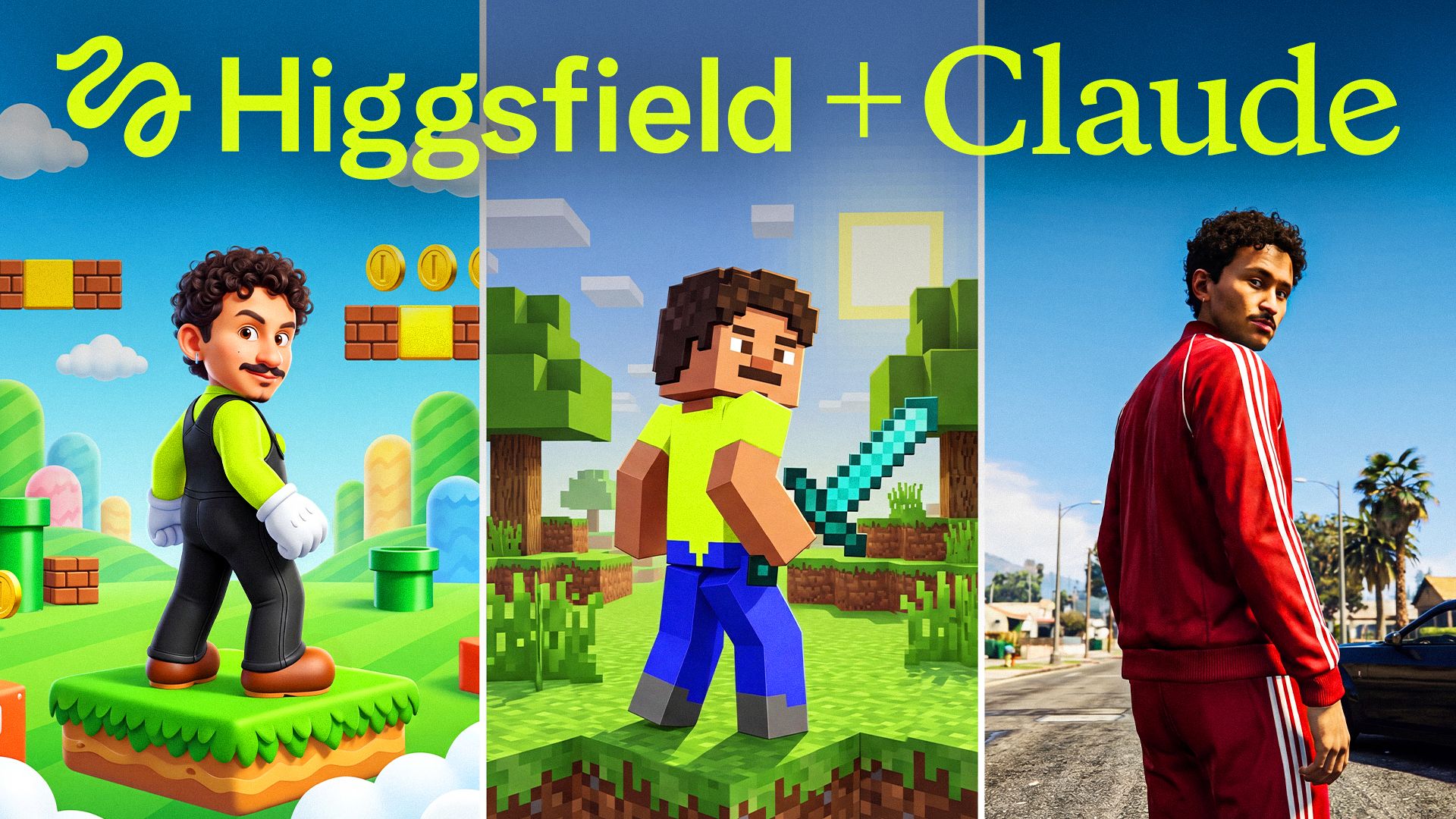
Claude Fable 5 + the Higgsfield MCP takes both walls down at once. Fable writes and directs the game; Higgsfield generates every character, texture and sound, hosts the live multiplayer match, and lists the finished game on a public marketplace. In this article we built three complete multiplayer games — pirates, a block-world shooter, and a webcam-controlled fruit slicer — for $68 total, published them, and woke up to nearly 4,000 players and 121 remixes. (We also handed all three to the studio behind CrossFire — 670M+ players — for an unscripted gut-check.)
Here's exactly how, with every prompt.
The Setup (30 seconds)
The whole pipeline runs on two pieces, and connecting them takes about half a minute.
1. Connect the Higgsfield MCP. Open Claude → Settings → Connectors → Add custom connector. Name it Higgsfield and paste the server URL: https://mcp.higgsfield.ai/mcp Click connect. Now Claude can generate real game assets and host live matches instead of returning gray boxes.
2. Add the Game Studio skill. This is a file that makes Claude behave like an actual game studio (more on what that means in Game 2). Drop it into your Claude chat to activate it. → Download the Game Studio Skill

Think of it this way: Claude is the brain that designs and writes the game; Higgsfield is what actually makes and hosts it.
Game 1 — Pirates (first-person)
What you're building: a first-person pirate game — crew a galleon, steer it, man the cannons, pull alongside an enemy ship and board it for a sword fight on deck.
Build a first-person pirate game where I sail a galleon, fire cannons at enemy ships, and board them for a sword fight on deck.
What it does: one sentence returns a playable game with every texture and sound generated from scratch — real wood on the hull, detailed cannons, characters that read as actual pirates and navy, a real ocean.
The difference the MCP makes: we ran the exact same sentence through Claude alone — no MCP, no skill. Same model, same working game underneath — but no skins, no textures, no ocean. Just gray shapes. That's the line between a tech demo and something people want to play. Fable writes the game; Higgsfield makes it look real.
Multiplayer with zero setup: a friend clicked a link and was in the match — Higgsfield hosted the game and synced both players automatically. No backend developer, no server rental, no networking code. The same prompt that builds the game also makes it joinable.
Game 2 — Blockfield (block-world shooter)
What you're building: a build-and-break block-world shooter — two teams, place and destroy blocks, fight the other side.
Build a first-person pirate game where I sail a galleon, fire cannons at enemy ships, and board them for a sword fight on deck
What it does — and what the skill is doing under the hood: this time the skill doesn't start coding. It interviews you first, the way a real studio interviews a client, then turns your answers into a full design document — mechanics, art direction, level structure, sound. That brief is what builds the game, not your one sentence. The skill is an experienced game-dev team that works before a single line of code gets written. Then it deploys itself: the same prompt that writes the game hosts it, ending in a live link you can send anyone — no deployment headaches.
The result has real detail. Each weapon has its own personality: the sniper fires slowly but zooms in and hits far harder; the bazooka launches rockets with a real smoke trail and blows through blocks that bullets can't touch.
Game 3 — NeonSlice (webcam-controlled)
What you're building: a fruit-slicing game with no controller, no mouse, no touchscreen — your webcam watches your hand and your fingertip is the blade (two hands supported).
Build a block-world shooter with two teams against each other, where I can place and destroy blocks and fight the opposite team
What it does: this is the one to remember. Under the hood a vision model handles the hand-tracking — but the hard part is everything around it. Fable and Higgsfield stitch the tracking, velocity prediction, physics and a fully playable game together in the browser, from a single prompt. No installs, no extra hardware. Just your hand.
Publish to the Marketplace (deploy ≠ publish)
Up to here the games live at private links you send people. When each game was finished, the skill asked whether to publish it to the marketplace — and that's a different thing entirely. A deployed game is one you send. A published game is one strangers discover, play, and remix on their own.
Why the timing matters: the marketplace launched this week and it's almost empty. Publish now and you're discovered first, played first, remixed first — and every play is free data telling you what's actually fun. It's the early-YouTube, early-App-Store window: in 2008, solo developers made fortunes on simple flashlight apps purely for being first with no competition. The advantage isn't only building games — it's being the only game in town when the players show up.
What that looked like overnight: we published three games, ran no ads, made no posts, told no one. By morning Blockfield alone had ~4,000 plays — up to 22 players in a single arena building, fighting and talking — and 121 people had remixed it: opened the game, changed it, and shipped their own version. One click after thinking "I could do that."
What It Costs — and How It Makes Money
We asked Claude to pull the full credit breakdown, failed generations included: $68 to build all three games start to finish. Not one line of code was typed by hand — every asset, the 2D art, the 3D buildings, the characters, the sound, was generated with Higgsfield.
The money works as a funnel:
Top of funnel (free): the marketplace. You host for nothing, real people play, and if they keep coming back, you've found something worth betting on.
Bottom of funnel (scale): distribution platforms. Because you own the code Claude wrote, you take the proven winner to the big digital distribution platforms — that's where it pays off.
The marketplace tells you what to bet on; the big platforms are where the bet cashes in.